Introduction
Mathematical education has been questioned and
renewed by various proposals that seek to transform its teaching through
active, participatory, and contextualized methodologies. One of these is
gamification, understood as the incorporation of elements from game design into
educational contexts to motivate and generate meaningful learning experiences (Werbach & Hunter,
2012; Kapp, 2012).
Although its use has spread to different educational levels and disciplinary
areas, in the field of mathematics, resistance, doubts, and limitations for its
implementation still persist. This situation raises a key question: why is a
strategy that has shown benefits in terms of motivation and participation still
marginalized in many mathematics classrooms, especially in contexts such as
Latin America?
In Latin America, the incorporation of
innovative approaches such as gamification faces structural and cultural
barriers that go beyond the individual will of the teacher. Recent studies show
that, although there is a favorable discourse towards pedagogical innovation,
in practice, teachers must deal with rigid curricula, lack of specific
training, and unfavorable institutional conditions (Zainuddin et al., 2020; Calderón,
2021).
In Bogotá, this gap between the ideal and the
possible is deepened by inequalities in access to resources, work overload, and
a traditional school culture that often privileges summative assessment over
meaningful participation. Thus, the use of gamification becomes more of an
exception than an established practice, even among those teachers who recognize
its pedagogical value.
The resistance of many students towards
mathematics is not only due to the difficulty of the content, but also to a
deteriorated emotional relationship with the subject, marked by anxiety, a
perception of irrelevance, and fear of error (Dondio et al., 2023). In the face of this panorama,
gamification emerges as a strategy that not only incorporates motivational
dynamics but also invites a rethinking of the very meaning of learning
mathematics. By proposing challenges, levels, constant feedback, and symbolic
rewards, spaces are opened for autonomous exploration, critical thinking, and
the reframing of error as an opportunity (Homer et al., 2020; Scolari et
al., 2018). Hence the
importance of inquiring not only into the effects of gamification on learning
but also into the role of the teacher as a mediator and designer of meaningful
experiences.
Various investigations have demonstrated that
gamification can favor both academic performance and motivation and the
development of socio-emotional skills, relying on dynamic, creative, and
intuitive tools that stimulate student participation (Páez et al., 2022). Furthermore, studies such as
those by Högberg
et al. (2019) point out
that gamified experiences are powerful inducers of positive emotional states
that strengthen the bond with learning. However, the success of this
methodology does not depend on the simple incorporation of game mechanics, but
on intentional pedagogical planning, capable of articulating playful elements
with formative objectives, disciplinary content, and the particular
characteristics of the students. In other words, gamification acquires
educational meaning when it ceases to be a recreational strategy and becomes a
purposeful didactic mediation, aimed at promoting permanent and meaningful
learning.
In the specific case of Bogotá, mathematics
teaching faces multiple challenges that go beyond the strictly academic.
Various studies have pointed out the need to promote more transversal and
creative learning environments that integrate gamification as a pedagogical
strategy to revitalize student interest (Criollo, 2023; Sarmiento, 2020;
Hernández, 2017).
However, these efforts take place in a context marked by socioeconomic
inequalities, low performance levels on standardized tests, and a notable
disinterest in the subject (Rubiano, 2023; Acevedo & Ortiz, 2020; Flórez, 2024).
To these difficulties are added cultural and
relational factors that affect the relationship of young people with knowledge,
the loss of the cultural value of school (De la Hoz & Maestre, 2024), tensions in school coexistence (Causaso & Pacheco,
2018), and processes of
exclusion that still persist in mathematics classes (García, 2025). In view of this panorama,
narrative and gamified strategies emerge as an opportunity to reconstruct the
pedagogical meaning of the discipline, recovering the joy of learning and
strengthening understanding from more meaningful experiences (León & Cruz, 2021).
This situation demonstrates the need to adapt
teaching methodologies and intentionally incorporate gamification in Bogotá's
schools, especially in the area of mathematics. In this scenario, it is
essential to understand how teachers perceive this strategy, their level of
knowledge about its theoretical foundations and possible applications, as well
as the attitudes they assume towards its curricular integration. Teacher
training is therefore configured as a decisive axis; the absence of specific
training in gamification can limit its implementation and significantly reduce
its pedagogical impact.
This article aims to reflect on the knowledge,
attitudes, and skills of mathematics teachers regarding gamification, in order
to understand the factors that influence its adoption or resistance within the
classroom. More than describing trends, it seeks to offer a critical and
comprehensive look at how teachers perceive this strategy, what conditions
facilitate its implementation, and what obstacles persist in the school
contexts of Bogotá.
The analysis presented here is part of the
doctoral project "Analysis of the knowledge and attitudes of mathematics
teachers in the implementation of gamification as a didactic strategy in public
schools in Bogotá," which has as one of its specific objectives to
diagnose the technical skills, knowledge, and attitudes that limit or favor the
effective incorporation of gamification in the classroom.
Based on this approach, a space for reflection
is proposed to rethink the teacher's role in pedagogical innovation,
recognizing that gamification is not a methodological fad, but an opportunity
to transform the teaching of mathematics from creativity, motivation, and a
meaningful relationship with knowledge.
The reflection is organized around five
fundamental axes: the level of teachers' knowledge about the principles and
elements of gamification; the predominant attitudes towards its use in
teaching; the personal and institutional factors that influence its adoption;
the strengths and weaknesses perceived in its implementation; and the
implications that these findings have for teacher training and professional
development in Bogotá. This approach seeks to articulate the investigative
perspective with a pedagogical and transformative reading of the teacher's
role, positioning gamification as a possible path towards more motivating,
inclusive, and creative practices in mathematics education.
The justification for this study lies in the
urgency of transforming mathematics teaching, overcoming the distance between
the theoretical possibilities offered by gamification and its scarce
implementation in classrooms, still marked by traditional approaches that limit
participation and creativity. Understanding teachers' perceptions and
experiences allows for the design of more context-adjusted support and training
strategies, capable of fostering the critical appropriation of active
methodologies. Reflecting on these practices not only contributes to didactic
innovation but also strengthens the professional commitment of the teacher as
an agent of change within public schools.
In this sense, the present work seeks to build
bridges between theory, practice, and pedagogical reflection, offering an
analytical framework that contributes to the continuous improvement of
mathematics teaching. Its results and discussions are consolidated as the basis
for future research that deepens the integration of gamification and its
potential to transform learning experiences in Latin American educational
contexts.
Theoretical framework
Understanding
the relationship between gamification and mathematics teaching requires an
analysis that transcends the instrumental and situates itself in the
pedagogical, cultural, and epistemological plane. In this sense, a space for
reflection is constituted where ideas, debates, and perspectives that support
the understanding of the addressed educational phenomenon converge. From a
critical perspective, the conceptual foundations of gamification, the attitudes
and knowledge of teachers towards didactic innovation, and the institutional
challenges that condition its application are analyzed. These three axes allow
for an integral reading of the problem, positioning the teacher not only as an
executor of strategies but as a reflective agent who interprets, transforms,
and re-signifies their practices in complex contexts such as those of public
schools in Bogotá.
Gamification in mathematics teaching: Foundations and pedagogical scope
Gamification
has emerged in recent decades as one of the most powerful strategies for
re-signifying the relationship between students and learning. Its purpose is
not limited to learning by playing but consists of incorporating the logics of
the game within pedagogical structures to enhance motivation, commitment, and a
sense of achievement (Werbach & Hunter, 2012; Kapp, 2012). From this
perspective, learning is conceived as an active and emotional experience, where
error ceases to be an obstacle and becomes an opportunity to explore, reflect,
and improve.
In the field
of mathematics education, gamification has shown positive effects on academic
performance, motivation, and the development of socio-emotional skills, thanks
to the use of dynamic, creative, and intuitive tools that promote student
participation (Páez et al., 2022). Likewise, it has been shown that gamified
experiences are powerful inducers of positive emotional states that strengthen
the affective bond with learning (Högberg et al., 2019). By
integrating challenges, levels, and constant feedback, autonomy, critical
thinking, and problem-solving ability are promoted from a more playful and
meaningful dimension (Homer et al., 2020; Scolari et al., 2018).
In this sense,
gamification in mathematics cannot be understood as a set of recreational
techniques but as a pedagogical approach that reconfigures the relationship
between emotion, cognition, and disciplinary knowledge. Its impact transcends
momentary motivation; it implies a change in the way students appropriate
mathematical knowledge, favoring the construction of lasting and meaningful
learning. Thus, gamification is projected as a tool to humanize teaching,
transforming the classroom into a space of discovery, participation, and
creativity.
Although the
main interest of this work focuses on teacher attitudes and knowledge, the
reviewed studies also show that gamification has a direct impact on student
motivation and performance, factors that in turn affect teachers' perception
and disposition towards its use. Recent research agrees that this methodology
generates more active and sustained participation in learning mathematics,
favoring the understanding of traditionally complex concepts and improvement in
academic performance. Niampira (2023), for example, documents significant advances in
the learning of fractions, algebraic terms, and basic operations, such as
addition, subtraction, multiplication, and division, from the implementation of
gamified strategies. These findings suggest that the transformative potential
of gamification does not lie solely in its playful component but in its
capacity to redefine the student's emotional and cognitive relationship with
mathematics, generating more motivating and meaningful learning environments.
In the Bogotá
context, various educational experiences have demonstrated the potential of
gamification as a tool for pedagogical mediation in mathematics teaching. Hernández and
Sarmiento (2022) document interventions based on the use of video
games and platforms like Scratch, aimed at strengthening geometry learning
through the creation of interactive environments. Similarly, Aldana (2020) describes
the design of gamified virtual spaces that integrate missions and challenges
for teaching fractions to seventh-grade students. These experiences show that
when gamification is articulated with problem-solving processes, feedback, and
formative assessment, students not only improve their academic performance but
also transform their attitude towards mathematics, perceiving it as a closer,
more challenging, and meaningful field. Thus, the playful experience becomes a
catalyst for motivation and conceptual understanding, reaffirming that
pedagogical innovation must be accompanied by a formative intentionality, not merely
a recreational one.
Similarly, the
implementation of gamified virtual learning environments has shown positive
effects on the development of mathematical competencies, particularly in
problem-solving, numerical thinking, and geometric comprehension. While some
studies show that student performance remains at basic levels, they also
highlight a greater disposition towards learning and a more active interaction
with digital resources. These experiences demonstrate that the use of missions,
scores, and rewards, which are characteristic elements of gamification, favor
motivation and persistence in the face of the challenges inherent in
mathematical learning (Castillo, 2021).
Beyond
immediate results, the incorporation of gamified strategies allows for the
creation of more inclusive and participatory environments, where error is
assumed as part of the process and constant feedback strengthens student
autonomy. Consequently, gamification in digital environments not only expands
didactic possibilities but also reconfigures the emotional relationship with
learning, generating meaningful experiences that transcend the mechanical
repetition of exercises and promote a deeper understanding of concepts.
Various
studies agree that gamification can significantly improve learning outcomes in
mathematics, especially when it incorporates immediate feedback mechanisms and
playful dynamics that facilitate understanding of content by presenting it in a
clearer and more attractive way. Furthermore, this methodology promotes
collaborative learning environments, in which students work as a team to
overcome challenges, thus strengthening their communication and problem-solving
skills (García,
2021).
However, the
literature also warns that the effectiveness of gamification depends on its
pedagogical design. García (2021) points out that inadequate planning or poor
integration by the teacher can reduce the expected positive impacts. In the
same vein, Rodríguez
and Visbal (2022) emphasize the need to reformulate traditional
didactic strategies through gamified proposals that promote a deep
understanding of mathematical concepts. All this underscores the importance of
the teacher not only mastering the technical aspects of gamification but also
understanding its pedagogical sense and integrating it as a tool coherent with
their formative objectives.
The incorporation of active methodologies like gamification in mathematics teaching
depends, to a great extent, on the dispositions and knowledge of teachers. It
is not enough for digital tools or innovative didactic strategies to exist;
their appropriation requires teachers capable of interpreting, adapting, and
re-signifying these proposals according to their school context. In this sense,
pedagogical knowledge and attitudes towards innovation constitute decisive
elements that mediate between theory and educational practice (Marcelo &
Vaillant, 2013; Fullan, 2007). Evidence shows that when
teachers understand the formative sense of gamification and feel competent to
apply it, its impact in the classroom is deeper and more sustained, while a
lack of understanding or confidence can generate rejection or superficial use
of the strategy (Calderón, 2021; Ponte et al., 2019).
Recent studies
show a notable variability in the level of knowledge that mathematics teachers
possess about gamification and its pedagogical principles. Although a
significant portion of the teaching staff has heard the term or has a general
understanding of its purpose, few manage to identify in depth the mechanics,
dynamics, and components of game design that support its educational
application (Werbach & Hunter, 2012). This conceptual gap reveals
that, beyond technological novelty, many teachers still perceive gamification
as a recreational resource, without recognizing its epistemological potential
to transform teaching. Understanding how rules, levels, or rewards can align
with learning objectives requires not only technical skills but also solid pedagogical
training that allows reinterpreting the logic of the game within teaching and
assessment processes.
A considerable
number of teachers associate gamification almost exclusively with the use of
points, badges, and leaderboards, reducing its scope to a practice of
superficial reward or competition. This view, known as
"pointification," reflects a limited understanding of the approach
and often leads to ineffective implementations, where game elements are added
decoratively, without a pedagogical integration coherent with learning
objectives. As Palacios and Cimas (2024) point out, although many
educators have heard of gamification, only a minority manage to distinguish the
types of players or the motivations that this strategy seeks to activate. This
gap between technical knowledge and pedagogical sense evidences the need for
deeper training in instructional design and motivation theories, so that
gamification is not reduced to a passing trend but consolidates as a
transformative tool for mathematical learning.
The absence of specific
training in gamification constitutes one of the most persistent factors
explaining the identified knowledge gaps among teachers. Cáliz, Cerón and Hernández
(2024) point out that when educators do not master the
necessary technological tools or didactic strategies, their capacity to design
innovative and meaningful learning experiences is limited. This lack not only
affects the integration of gamification in the classroom but also widens the
digital and pedagogical gap between those who are trained to teach and those
who learn in technology-mediated environments.
In this sense,
gamification represents an opportunity to reconfigure teaching processes,
integrating game dynamics that promote exploration, creativity, and active
learning. However, its implementation demands continuous teacher training,
oriented towards understanding both the theoretical foundations of the approach
and its potential to strengthen student motivation and academic performance.
The most
consistent results in the implementation of gamified strategies are associated
with training processes that equip teachers in their design and pedagogical
integration. When the instructions for developing activities are clear,
dynamic, and articulated with approaches of meaningful and autonomous learning,
more participatory and effective environments are achieved (Banfield &
Wilkerson, 2014; Elles & Gutiérrez, 2021). In these
cases, gamification ceases to be an intuitive practice to become a conscious
didactic strategy, where the teacher assumes the role of designer of learning
experiences rather than a transmitter of content.
Likewise,
teachers who receive formal training in gamification develop a more analytical
understanding of how game elements can enhance motivation, collaboration, and
critical thinking in mathematics. Training, then, not only expands theoretical
knowledge but also strengthens the technical skills and professional confidence
necessary to integrate digital resources and interactive environments into
daily practice. In this sense,
teacher training becomes the bridge between innovative intention and real transformation
of teaching.
Although studies on teacher attitude
towards gamification are still scarce (Martí et al., 2016), existing research shows a positive
trend towards its use in the classroom. Claros et al. (2020) point
out that many university professors express a favorable disposition to
integrate playful elements into their classes, recognizing their potential to
dynamize teaching and strengthen the pedagogical bond with students. In the
same line, Sagnier
et al. (2020) highlight that the proactive attitude
of the teaching
staff becomes an effective means to incorporate innovations, as those who positively value gamification tend to explore and adapt it more frequently.
In the Bogotá context, Criollo (2023)
emphasizes that gamified strategies in mathematics elevate student motivation
and commitment, generating more attractive and participatory learning
environments. These findings suggest that teacher attitude acts as a catalyst
for educational change; when teachers believe in the pedagogical value of
innovation, teaching transforms. However, this individual disposition requires
institutional support and formative accompaniment to consolidate as a
sustainable practice within school culture.
Most studies
agree that teachers perceive gamification as an innovative strategy capable of
increasing student motivation and commitment. Its potential to transform the
classroom into a more dynamic and participatory space makes it a valuable tool
for reducing mathematical anxiety and fostering participation. However, these
positive attitudes often coexist with concerns and resistances related to its
practical application. Tafur et al. (2023) warn that many teachers
who use gamification do not fully understand
the elements that structure it, which limits
its impact on teaching and learning processes.
Likewise,
Cunza et al. (2020) found that teachers with greater affinity for games often
also show greater apprehension towards their
implementation, fearing that the playful component may displace curricular
content or trivialize mathematical learning. These tensions reflect a central
challenge: achieving a balance between the playful dimension and academic
rigor, so that gamification is not perceived as a distraction but as an
opportunity to rethink the relationship between emotion, knwledge, and
motivation in mathematics teaching.
Another aspect
to consider in the adoption of gamification has to do with the material and
organizational conditions that teachers face. Designing gamified experiences
requires time, creativity, and resources, which represents a significant
challenge for those working with extensive workloads or in institutions with
limited technological infrastructure. The lack of access to adequate digital
tools and scarce institutional training in the use of interactive platforms not
only restricts the possibilities of innovation but also affects teachers'
attitudes, generating frustration and demotivation towards the implementation
of these strategies. In contrast, teachers who have achieved successful
gamification experiences report highly favorable attitudes, accompanied by
improvements in academic performance, student collaboration, and classroom
climate. These cases show that perceived self-efficacy, understood as the
teacher's confidence in their ability to successfully integrate gamification,
becomes a determining predictor of the disposition towards pedagogical change.
When the teacher recognizes themselves as an agent of transformation,
gamification ceases to be an external technique and becomes a meaningful
practice that enhances learning and creativity.
Institutional challenges and formative projections
Favorable
attitudes toward gamification lose strength when confronted with institutional
contexts not conducive to innovation. The implementation of playful strategies
in mathematics teaching does not depend solely on the enthusiasm or individual
preparation of the teacher, but on a network of internal and external factors
that determine its viability. Among the internal factors are training,
self-efficacy, and pedagogical beliefs; among the external ones, technological
resources, administrative support, curricular alignment, and the socioeconomic
conditions of the students. In this sense, gamification cannot be understood
only as a methodology, but as an indicator of the tensions and possibilities of
the educational system; its success or failure reveals to what extent the
school is willing to reinvent itself to respond to the challenges of
contemporary education.
The identified challenges reflect a reality
shared by numerous educational institutions in Bogotá, where teacher training
and the availability of technological resources remain critical factors for
pedagogical innovation. Insufficient specific training in designing gamified
experiences, added to deficient curricular integration, limits the
effectiveness of this methodology and prevents its benefits from consolidating
over time (Céspedes,
2022). To this are added persistent problems such as high failure rates in
mathematics and low student motivation, evidenced by Castaño and Vargas (2020),
who warn that interest in learning decreases when pedagogical strategies fail
to connect with the realities and languages of the students.
The scarcity
of technological resources, connectivity difficulties, and the lack of
institutional support worsen this panorama, especially in vulnerable contexts.
These factors not only restrict innovation but also deepen educational
inequalities, reproducing the distance between transformation discourses and
real possibilities for action in the classroom.
The identified
limitations should not be understood solely as obstacles, but also as
opportunities for pedagogical and technological innovation. The implementation
of gamification in mathematics teaching offers a fertile field to rethink
teaching practice, provided teachers receive adequate training and equitable
access to necessary resources. With appropriate institutional support, teachers
can become pioneers of educational change, developing models and good practices
that benefit the entire school community.
Collaboration
between universities, educational authorities, and school institutions is
essential to build continuous training programs and contextualized pedagogical
materials. However, this purpose requires sustained investment in technological
infrastructure and teacher training, ensuring the participation of all
teachers, regardless of the type of institution or its geographical location.
Only in this way will it be possible for gamification to cease being an
isolated experience and consolidate as a systematic strategy of educational
innovation, capable of transforming teaching and learning dynamics in Bogotá's
public classrooms.
Strengthening
teacher training in gamification requires going beyond simple technical
training. It is about rethinking educational policies and institutional
environments so that innovation does not depend solely on individual
enthusiasm, but on a school culture that sustains it. Investment in
technological infrastructure must be accompanied by continuous and
collaborative formative processes, where teachers can design meaningful
experiences and reflect on their practice. Only in contexts that articulate support,
training, and a shared pedagogical vision can gamification consolidate as a
sustainable strategy for educational transformation, capable of humanizing
mathematics teaching and contributing to more equitable and creative education
in Bogotá.
Specialized
literature points out that there is no single definition of gamification, but a
wide diversity of interpretations that reflect its conceptual evolution and
adaptation to different educational contexts (Lozada & Betancurt, 2015).
Beyond its technical nature, gamification is based on constructivist and
connectivist principles, which conceive learning as an active, social process
mediated by interaction. From this perspective, its efficacy lies not only in
playful or technological elements, but in its capacity to stimulate motivation,
favor meaningful participation, and generate environments where error is
assumed as part of the learning process.
Its
psychological foundations centered on motivation, autonomy, self-efficacy, and
applied game design models in education allow us to understand why gamification
works, not as a methodological adornment, but as a strategy that re-signifies
the meaning of learning. Training teachers in this area involves preparing them
to create activities adapted to curricular objectives and the characteristics
of their students, where game mechanics, dynamics, and components align with
clear learning purposes. Designs of this type allow students to develop
numerical thinking and problem-solving in interactive and challenging
environments (Becerra et al., 2023). Along the same lines, Cárdenas and Chacón
(2023) propose the implementation of gamified mathematical
challenges as a strategy to strengthen student motivation, autonomy, and
participation, demonstrating that pedagogical creativity can transform
traditional teaching into a meaningful and collaborative experience.
The use of
technological tools and platforms represents an essential component in teacher
training for the implementation of gamification. It is not just about learning
to use software or applications, but understanding how these resources can be
integrated in a meaningful and contextualized manner into teaching and learning
processes. In this regard, the National Ministry of Education (2018) has
promoted spaces like the Colombia 4.0 workshop in Bogotá, where 80 preschool,
elementary, and high school teachers were trained in the use of gamified tools
from the educational portal Colombia Aprende.
Complementarily,
universities in the country have developed projects aimed at strengthening
teachers' technological competencies through immersive gamified experiences.
The University
of Santander (2025), for example, promotes an innovative
methodology that accompanies real pedagogical practice, considering the
institutional and community contexts of the teachers. These initiatives show
that technological adoption cannot be reduced to instrumental mastery; it must
be understood as a comprehensive formative experience, where technology is put
at the service of creativity, collaboration, and educational transformation.
The evaluation
of gamification constitutes a central challenge in educational innovation
processes. Training teachers in this competence involves teaching them to
assess the effectiveness of gamified strategies not only based on academic
results, but also considering indicators of student motivation, participation,
and commitment. Although in Colombia there have not yet been specific studies
on teacher evaluation of gamified strategies in mathematics, previous research
offers relevant conceptual foundations (Mera, 2016; Cáceres & Gómez,
2022; Cárdenas & Chacón, 2023).
This research
agrees that evaluation should be conceived as a formative and reflective
process, allowing the teacher to analyze not only what students learned, but
how they learned it and what emotions, decisions, and cognitive strategies were
involved in that learning. In this sense, evaluating gamification involves
rethinking the criteria of educational success, incorporating affective and
collaborative dimensions that transcend traditional grading and consolidate a
more human, participatory, and meaningful mathematics teaching.
To overcome
the identified barriers and fully harness the potential of gamification in
mathematics teaching in Bogotá, it is necessary to move towards comprehensive
actions involving both educational policymakers and practicing teachers. It is
not only about incorporating technological tools or game dynamics, but
reconfiguring the institutional, formative, and cultural conditions that allow
gamification to consolidate as a sustainable pedagogical strategy, capable of
transforming the teaching and learning of mathematics in the city's public
schools.
Ensuring that
all educational institutions in Bogotá, especially public ones, have adequate
technological infrastructure is an indispensable condition for implementing
gamified strategies. This includes equitable access to connectivity, updated
devices and educational software, as well as safe and sustainable digital
environments. According to the National Ministry of Education (2025),
"educational infrastructure not only supports the teaching-learning
process, but also plays a crucial role in creating an inclusive, motivating,
and healthy environment for the entire educational community."
In line with
this, the regional convergence strategic line of the National Development
Plan 2022–2026 emphasizes the need to "promote territorial equity and
overcome gaps in access to education from preschool to higher education" (Findeter, 2023).
This vision reinforces the principle that pedagogical innovation, and
particularly gamification, cannot consolidate without material conditions
guaranteeing universal access to technology as a tool for learning and
educational justice.
It is
essential to promote the creation, dissemination, and use of Open Educational
Resources (OER) specifically designed for the Colombian mathematics curriculum.
These materials can include digital platforms, educational games, design
templates, pedagogical guides, and collaborative repositories that facilitate
adaptation by teachers to different levels and school contexts. Besides
promoting methodological innovation, OERs contribute to democratizing access to
knowledge and strengthening teacher autonomy, allowing teachers to share,
modify, and improve materials according to their students' needs. Their
development requires joint work between universities, ministries, and teacher
communities, ensuring these resources are free, accessible, and culturally relevant,
in coherence with an open and equitable public education.
It is
indispensable to incorporate gamification as a structural component in initial
and continuous training programs for mathematics teachers. In this way, future
educators can develop pedagogical and technological competencies that allow
them to apply active methodologies from the start of their professional
practice. As stated by Lozada and Betancur (2015), "the constant need to
update educational methods must be considered to improve the quality of
education, which depends mainly on the content taught, the needs of society,
and coverage." From this perspective, teacher training must go beyond
technical updating; it implies rethinking teaching as a space for creativity,
autonomy, and commitment to innovation, where gamification becomes a key tool for
connecting mathematical learning with the realities and motivations of
students.
It is
fundamental to promote action-research as a permanent practice among
mathematics teachers, allowing them to analyze, evaluate, and improve the
effectiveness of gamification in their own contexts. This approach turns the
classroom into a pedagogical laboratory, where reflection on practice generates
situated knowledge relevant to the educational realities of Bogotá. Besides
strengthening professional autonomy, action-research promotes a collaborative
and critical teaching culture, in which educators not only apply innovative
methodologies but also construct and validate their own pedagogical knowledge,
thus contributing to the development of more contextualized, participatory, and
sustainable education.
Methodology
This
reflection is framed within an analytical and critical review related to
gamification in mathematics teaching and teacher attitudes towards its
implementation. The work is based on a process of theoretical review, but
approached from an interpretive perspective, focused on understanding how
previous studies have explained the relationship between pedagogical
innovation, teacher training, and educational practice. More than applying a
meta-analysis protocol, the interest lay in identifying the main debates,
tensions, and gaps present in the literature, to contribute a contextualized
reading of the phenomenon within the framework of mathematics education in
Bogotá.
For the
development of this reflection, an exhaustive documentary review was carried
out aimed at recognizing advances, challenges, and contemporary approaches
regarding gamification in mathematics teaching. Recent and representative
studies from both the international sphere and the Latin American context were
prioritized, to articulate global perspectives with the educational
particularities of Bogotá. This analysis allowed building a solid theoretical
base that supports the reflection and accounts for the main debates surrounding
the incorporation of active methodologies in mathematics education.
In addition to
reviewing specialized academic sources, a process of contrasting and dialoguing
between different theoretical perspectives was carried out, with the purpose of
broadening the understanding of the phenomenon and avoiding a fragmented view of
gamification. This exercise allowed identifying coincidences, tensions, and
conceptual gaps in studies on mathematics education, as well as recognizing the
most recent approaches to teacher training and attitudes towards innovation.
The articulation between classical authors and contemporary contributions
enriched the analysis, offering an integral vision that combines theoretical
foundations, classroom experiences, and pedagogical reflections.
The selection
of literature supporting this reflection was based on conceptual and
pedagogical criteria rather than procedural ones. Those studies that offered
significant contributions on teacher knowledge, attitudes, and perceptions
regarding gamification and its relationship with mathematics teaching were
prioritized. Likewise, research that addressed educational innovation from
qualitative, quantitative, or mixed approaches, contributing to understanding
the human and contextual dimension of pedagogical practice, was considered.
Both
scientific articles and book chapters, as well as documented experiences and
case studies that allowed contrasting international perspectives with Latin
American realities, were included. The selection responded to criteria of
relevance and timeliness, rather than exhaustiveness, with the purpose of
constructing a critical and situated vision of the analyzed educational
phenomenon.
Similarly, the
analysis process involved an intentional delimitation of the focus, avoiding
the inclusion of studies that did not directly address mathematics teaching or
the teacher's role regarding gamification. Works focused exclusively on student
learning or game experiences disconnected from pedagogical analysis were
discarded. This decision allowed maintaining the thematic and epistemological
coherence of the reflection, focusing it on teaching practice as a privileged
space for understanding the reach and limitations of gamification in the
classroom.
Likewise,
priority was given to academic texts with scientific backing, excluding
dissemination materials or proposals without research foundation. This
selection did not seek to restrict debate, but to preserve the rigor and
pertinence of the analysis, ensuring that the sources provided evidence or
solid arguments about the examined educational phenomenon.
The analysis
process was developed in several interpretive stages that allowed organizing
and understanding the information from a critical perspective. First, an
identification of predominant approaches in recent literature on gamification
and mathematics teaching was carried out, recognizing the contexts where this
strategy has had greater development and the factors that have limited its
adoption.
Subsequently,
an analytical and comparative reading of the selected studies was undertaken,
with the purpose of identifying convergences, contradictions, and conceptual
gaps. This phase focused on reconstructing the educational discourse that has
been configured around the teacher's role, making visible how attitudes,
knowledge, and beliefs influence the implementation of gamification.
Finally, the
information was synthesized into thematic axes that articulate the reflection
presented in this article: gamification as an emerging pedagogical approach,
teacher training and attitude towards methodological innovation, and the
institutional challenges conditioning its integration in the classroom. This
process allowed transcending the description of results and advancing towards
an interpretive reading of the educational phenomenon, coherent with the
reflective purpose of this work.
Search strategy
The search
strategy was designed to identify the most relevant and up-to-date literature
in high-impact academic databases. Combinations of keywords in Spanish and
English were used, including terms related to 'gamification', 'mathematics',
'teachers', 'attitudes', 'knowledge', 'perception', 'training', and
'education'. The databases consulted were Scopus, Web of Science, ERIC, Scielo, Dialnet, and Google
Scholar, selected for their coverage in the field of education and their
indexing of quality scientific journals. The search was limited to publications
from 2010 to the current date (2025) to ensure the relevance and currency of
the studies. The general search string used was as follows:
(gamificación OR gamification) AND (matemáticas
OR mathematics) AND (docentes OR teachers OR
professors OR educators) AND (actitudes OR attitudes
OR percepción OR perception OR conocimiento
OR knowledge OR formación OR training) AND (educación OR education)
In addition
to the database search, a manual search was conducted in the
reference lists of identified key articles, in institutional
repositories, and in specialized journals in mathematics education and
gamification to identify additional studies that might not have been captured
by the initial search. This search via other methods allowed expanding the
scope of the review and ensuring the inclusion of relevant literature.
Eligibility criteria
For the
selection of studies, clear and predefined inclusion and exclusion criteria
were established:
Inclusion criteria
•
Empirical studies:
Quantitative, qualitative, or mixed-methods works that
investigate teachers' knowledge, attitudes, or perceptions regarding
gamification in mathematics teaching.
•
Publication status:
Articles published in peer-reviewed scientific journals, book chapters, or
research works (theses) were included.
•
Data:
Studies had to report the author's institutional
affiliation.
•
Language:
Study reports had to be available in English or have a partial English
translation in which the methods and results were clearly described.
•
Thematic focus and
educational level: Studies that included gamification at any
educational level (primary, secondary, higher education) as
long as the focus was mathematics teaching.
•
Type and quality of
included studies: Studies that included primary data or
systematic reviews that met the quality criteria.
Screening:
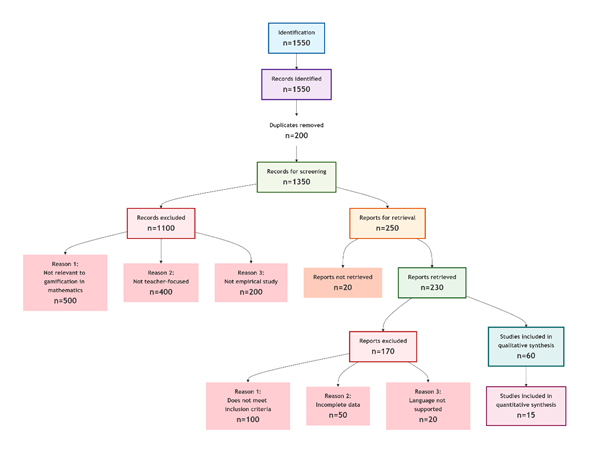
All identified records were imported into a reference manager to remove
duplicates. 200 duplicate
records were removed, leaving 1350
records for screening. At this stage, the titles and abstracts of the remaining
records were examined to assess their relevance against the inclusion criteria.
1100 records
were excluded at this stage for the following main reasons:
•
Reason 1:
Not relevant for gamification in mathematics (n=500):
These studies addressed gamification in other areas of knowledge or did not
focus on its specific application in mathematics.
•
Reason 2:
Not focused on teachers (n=400):
The studies focused on the impact of gamification on students, without
analyzing teachers' knowledge, attitudes, or perceptions.
•
Reason 3:
Not an empirical study (n=200):
These were theoretical review articles, essays, opinions, or project
descriptions without a clear empirical research methodology.
After
screening, 250 records remained and proceeded
to the next phase.
Eligibility
and inclusion: The 250
records selected in the screening phase were retrieved in full text. An attempt
was made to retrieve 250
reports, of which 230
were retrieved and 20
could not be retrieved (e.g., restricted access, broken links). The 230 retrieved reports were
assessed in full text by two independent reviewers to determine their final
eligibility. 170 reports
were excluded at this stage for the following reasons:
•
Reason 1:
Does not meet inclusion criteria (n=100):
Despite passing the initial screening, the full-text reading revealed they did
not meet all inclusion criteria (e.g., not an empirical study, not focused on
teachers or mathematics).
•
Reason 2:
Incomplete data (n=50):
The study did not provide sufficient information on methodology or results to
be included in the analysis.
•
Reason 3:
Unsupported language (n=20):
Although Spanish and English were prioritized, some retrieved studies were in
other languages not handled by the reviewers.
Finally, 60 studies were included in the
qualitative synthesis. Of these, 15
studies provided quantitative data allowing their inclusion in a quantitative
synthesis (meta-analysis, if applicable, or descriptive analysis of numerical
data).
PRISMA Flow Diagram
The study
selection process is summarized in the following PRISMA flow diagram (Figure
1):
Figure 1
PRISMA flow diagram of the study selection
process
Note:
Own elaboration (2025).
Data extraction and synthesis
For
each included study, the following relevant data were extracted:
·
General information: Author(s), year of publication, title, type of publication (article,
thesis, other).
·
Study characteristics: Research design (quantitative, qualitative, mixed-methods),
population and sample (number of teachers, educational level, geographical
location), context (type of institution, specific mathematics area).
·
Variables of interest: Instruments used to measure knowledge, attitudes, or perceptions about
gamification; key results related to these variables.
·
Main findings: Synthesis of the most relevant results, including perceived strengths
and weaknesses of gamification, influencing factors, and recommendations.
Data synthesis was conducted narratively
for qualitative findings and descriptively for quantitative data. Studies were
grouped according to emerging themes related to teacher knowledge and
attitudes, identifying patterns, inconsistencies, and gaps in the literature. Special attention was paid to studies
conducted in contexts similar to Bogotá or in Colombia
to contextualize the findings. The methodological quality of the included
studies was assessed using appropriate critical appraisal tools for each research
design type, although the details of this assessment are presented in the
Results section.
Results
The systematic literature review,
following the PRISMA methodology, allowed for the identification and synthesis
of key findings related to mathematics teachers' knowledge and attitudes
towards gamification. A total of 60 studies were included in the
qualitative synthesis, and of these, 15 provided quantitative data that
contributed to a deeper understanding of the variables of interest. The results
are presented in three main subsections: Level of teacher knowledge about
gamification, teacher attitudes towards gamification, and influencing factors
and perceptions of strengths and weaknesses.
Level of teacher knowledge
about gamification
The reviewed studies indicate
variability in the level of knowledge of mathematics teachers regarding the
principles and elements of gamification. While a significant proportion of
educators have heard the term or have a basic understanding of its concept, a
deep knowledge of game mechanics, dynamics, and components, as proposed by Werbach and Hunter (2012), is less common.
Many teachers primarily associate
gamification with the use of points, badges, and leaderboards (PBLs),
suggesting a superficial understanding often referred to as "pointification." This limited view can lead to
ineffective implementation of gamification, where game elements are added
without meaningful pedagogical integration with learning objectives. It is
known from international studies that although some teachers are familiar with
the term gamification at some point, only a small group is
able to correctly identify the different types of players or the
underlying motivations that gamification seeks to activate (Palacios and Cimas, 2024).
The lack of specific training in
gamification is a recurring factor explaining these knowledge gaps. According
to Cáliz, Cerón and Hernández
(2024), students who lack the necessary
knowledge to handle technological equipment and tools face obstacles in their
learning process and the development of digital competencies. This lack of
knowledge creates a gap among students. Gamification offers a possible solution
by providing an innovative approach that integrates game elements to facilitate
learning processes and acquire new knowledge that improves students' academic
performance.
Positive results in students are related
to precise instructions for the development of applied activities, in a
dynamic, diverse, and harmonious manner, through pedagogy, didactics, and
gamification strategies, with designs that incorporate meaningful and
autonomous learning (Banfield and Wilkerson, 2014; Elles and
Gutiérrez, 2021). Likewise, when teachers receive
formal training in the design and implementation of gamified strategies, they
demonstrate significantly greater knowledge and a more nuanced understanding of
how gamification can be used to enhance mathematics learning. In this way,
training not only improves familiarity with theoretical concepts but also
equips teachers with the technical skills necessary to integrate digital tools
and gamified platforms into their practices.
Teacher attitudes
towards gamification
There are few studies concerning teacher
attitudes towards gamification in educational institutions (Martí, et al. 2016). However, there is a positive attitude
among university teachers regarding the use of gamification in their classes (Claros, et al. 2020). It is known that teachers having an inclination towards using gamification and
perceptions towards such innovations constitutes an effective means in teaching
(Sagnier et al., 2020).
Similarly, Criollo (2023) has
mentioned that a gamified strategy in mathematics elevates student motivation
and commitment, energizes the classroom environment, and makes content more
attractive, in the Bogotá context. These nuances occur because teacher
attitudes are positive.
Most studies indicate that educators
perceive gamification as an innovative strategy with the potential to increase
student motivation and commitment. Its capacity to transform the classroom into
a more dynamic and attractive environment is valued, which can reduce
mathematical anxiety and improve student participation. However, these positive
attitudes often coexist with concerns and resistance. Some studies (Tafur et al. 2023) argue that teachers who use
gamification do not always understand the elements that constitute it, which
affects the teaching-learning process to some extent. Research has found that
teachers with greater affinity for games show more concern about its application in the classroom compared to those with less
affinity (Cunza et al. 2020). Hence the perception that gamification may divert focus from
essential curricular content or trivialize mathematics learning.
Another relevant aspect is that
designing effective gamified experiences requires time, creativity, and
resources, which can be a challenge for teachers with tight schedules and
limited resources. The lack of access to adequate digital tools or insufficient
technological infrastructure in educational institutions also negatively
influences teacher attitudes, generating frustration and demotivation to adopt
these strategies.
In contrast, teachers who have
experienced success with gamification in their classrooms report very favorable
attitudes, highlighting improvements in academic performance, student
collaboration, and the overall classroom atmosphere. Perceived self-efficacy,
i.e., the teacher's confidence in their ability to successfully implement
gamification, is a significant predictor of positive attitudes and the
willingness to integrate this methodology into their practices.
Influencing Factors and Perceptions of
Strengths and Weaknesses
The implementation of gamification in mathematics teaching is influenced by a
variety of factors, both internal (related to the teacher) and external
(related to the educational context). The reviewed studies identify the
following key factors:
Internal
factors
·
Prior training level: It has already been indicated above that specific training is
fundamental for deep knowledge and positive attitudes when implementing
gamification in mathematics teaching. Indeed, research conducted (Ponce, 2024) confirms that the fact that
gamification is not carried out in different institutions has to do with
teacher training, but also with the availability of resources and institutional
support. Likewise, the incorporation of digital tools depends on teachers'
digital skills and competencies (Rojas and Gallesse, 2025). However, its
implementation faces several challenges, including structural limitations, lack
of time, knowledge and skills on the part of teachers, and difficulties in
designing effective and creative gamified activities (Quimí
et al. 2024).
·
Teaching experience: Teachers with more years of experience may show greater resistance
to change, while younger or less experienced teachers may be more open to
innovation (Guillén, 2025).
·
Perceived self-efficacy: Confidence in one's own abilities to design and implement
gamification is a strong predictor of its adoption. Indeed, studies conducted
by Perochena
et al (2020) indicate that the capacity to innovate
and incorporate changes, and satisfaction with one's own work, are closely
linked to self-efficacy.
·
Pedagogical beliefs: Teachers' teaching philosophies influence their openness to active
and playful methodologies. But they are also linked to their attitudes towards
the use of communication technologies (Letwinsky, 2017; OECD, 2019b).
External factors
·
Resource availability and
institutional support: Access to technology, gamified
platforms, and teaching materials is fundamental. However, the support of
school administration, the availability of time for planning and training, and
the recognition of innovation are important. In this vein, research focused on
rural gamification in the Bananera zone (Magdalena) concludes that, although
teachers see its potential, many face resource and
time limitations for planning. This excessive demand can prevent a deep and
sustained pedagogical implementation (Ponce, 2024).
·
Curricular alignment: The perception that gamification can be integrated coherently with
the objectives and content of the mathematics curriculum is vital for its
sustained adoption. The work of Ponce (2025) emphasizes that strategic planning is the cornerstone for incorporating
gamification in correspondence with educational objectives, competency
standards, and subject area plans. This shows that it is not enough to
introduce playful elements; they must be designed with pedagogical coherence in
mind to have a real impact on learning.
·
Socioeconomic context: The socioeconomic conditions of students and the institution can
influence the viability and type of gamified strategies to be implemented.
According to research by García (2025)
the mere provision of technology is not sufficient to address digital
competencies. Adequate pedagogical support and the implementation of inclusive
and equitable educational policies are required. It must be taken
into account that "only 51.9 percent of households at the national
level in Colombia have access to the Internet" (Departamento
Administrativo Nacional de Estadística
de Colombia, 2020).
Regarding perceptions about the
strengths of gamification in the mathematics classroom, teachers consistently
highlight:
·
Increased motivation and
commitment: Gamification makes learning more
fun and attractive, which translates into greater student participation.
Gamification generates positive changes in student behavior and attitude, the
process becomes pleasant and motivates knowledge appropriation (Mera, 2016). Experiences conducted with students
from schools in Popayán confirm that 98% of 340
participants feel motivated and the applications used by teachers have allowed
them to easily understand the content (Santa María, 2011 cited by Mera, 2016). Similarly, it has been achieved in
international studies conducted in Spain (Cáceres
and Gómez, 2022) that play elevates student motivation.
·
Improved academic
performance: The results obtained by
performance levels in mathematics in the "Saber 11" tests in 2024-2
in the country's schools and published by the Colombian Institute for
Educational Evaluation (ICFES, 2025)
reveal the following:
Table
Schools in Bogotá by performance levels in mathematics in the "Saber
11" tests in 2024-2
|
Range by level |
Instituciones |
Secciones |
Evaluados |
% eval. |
Promedio ponderado |
|
<35 |
1 |
1 |
1 |
0,00 |
31,00 |
|
36-51 |
221 |
376 |
15.853 |
20,43 |
47,91 |
|
51-70 |
852 |
1026 |
59.845 |
77,11 |
56,96 |
|
>71 |
38 |
39 |
1.915 |
2,47 |
73,68 |
|
Total general |
1112 |
1442 |
77.614 |
100,00% |
55,53 |
Note: Prepared by the author with data from Icfes
2024-1.
The results show that 20.43% of the students (15,853) are placed at
Level 2, which indicates that the students read specific information (a piece
of data, for example) related to everyday situations and presented in tables or
graphs with an explicit scale, grid, or at least horizontal lines. Furthermore,
they demonstrate that:
(a) They compare data from two variables represented in the same graph
without needing to perform arithmetic operations. (b) They identify
representative values or points in different types of records based on the
meaning they have in the situation. (c) They compare the probability of simple
events (favorable cases/possible cases) when the possible cases are the same in
both events and in contexts similar to those presented
in the classroom. (d) They make decisions about the truthfulness or falsity of
a statement when it can be explained by verbalizing the direct reading made of
the information. (e) They change bar graphs to double-entry tables. (f) They
recognize and interpret, according to the context, the meaning of simple
average, mode, greater, lesser, maximum, and minimum. These students come from
approximately 221 schools (Icfes, 2025, p. 3).
The majority of students (77.11% or 59,845)
are concentrated at Level 3. These results, representing 852 institutions,
point to traditional teaching centered on mechanical exercises more than on
critical thinking. Icfes notes that these students
need to strengthen the application of concepts in real contexts, through
technological tools and problems linked to their environment. These results
suggest that in addition to the domains of Levels 1 and 2, the students know how
to:
a) Select the graph (which can be a double-entry graph corresponding to
the information in a table, or based on verbalizations
(desired growth or growth characteristics), taking into
account for the selection the scale, the type of variable, and the type
of graph. (b) Compare graphic information that requires some arithmetic
manipulations. (c) Point out information represented in non-conventional
formats (maps or infographics). (d) Recognize errors that occurred when
performing a transformation between different types of records. (e) Recognize
flat developments of a three-dimensional shape and vice versa. (f) Compare the
probability of simple events in various contexts (favorable cases/possible
cases), even when the possible cases of each event are different. (g) Select
information necessary to solve problems involving arithmetic operations. (h)
Select information necessary to solve problems involving measurable
characteristics of elementary geometric figures (triangles, quadrilaterals, and
circles). (i) They change the scale when the
transformation is not conventional. (j) Justify statements using approaches and
arithmetic operations or by making direct use of a concept, that is, based on a
single argument. (k) Identify relevant information when the type of record
contains information from more than three categories. (l) Perform simple
algebraic manipulations (arithmetic of like terms) that are basic, but with
limitations in skills such as graph interpretation and abstract reasoning (Icfes, 2025, p. 4).
Finally, only 2.47% (1,915 students) reach the
Advanced Level, demonstrating excellent performance in mathematical modeling
and argumentation. These cases, present in around 38 schools, are usually
associated with institutions with innovative programs, use of educational
technologies, and cross-curricular projects. The gap between these schools and
those with low results evidences inequalities in
resources and methodologies, which demands policies to share good practices and
reduce disparities in educational quality. The indicators indicate the
following about this level:
The evaluated person who is placed at Level 4, in addition to what is
described in Levels 1, 2, and 3, demonstrates that: (a) They solve problems
that require interpreting information from dependent events. (b) They perform
transformations of subsets of information that may require the use of complex
operations (percentage calculations). (c) They solve problems that require
constructing an auxiliary representation (graphs and formulas) as an
intermediate step for their solution. (d) They model using algebraic language
information given in natural language, tables, or geometric representations.
(e) They manipulate algebraic or arithmetic expressions using the properties of
operations. (f) They model non-explicit variational phenomena using symbolic
language or graphs. (g) They recognize in different formats (trees, lists, or diagrams) the sample space of a random experiment.
(h) They solve counting problems that require the use of permutations. (i) They justify whether there is a lack of information in a
problem situation to make a decision. (j) They make
decisions about the truthfulness or falsity of a statement when it requires the
use of several properties or formal conceptualizations (Icfes, 2025, p. 5).
Finally, it should be noted that the results of the Saber 11 tests
indicate that the vast majority of students have
Insufficient or Minimal performance in mathematics, evidencing difficulties in
motivation and meaningful learning. Gamification emerges as a key pedagogical
strategy by transforming content into interactive challenges, encouraging
participation and the development of competencies, as already indicated in this
article and substantiated by different studies. By integrating game mechanics
(levels, rewards, and immediate feedback), it could improve performance in the
most critical groups while consolidating skills at advanced levels in learning
mathematical concepts and problem-solving. Likewise, gamification is an
innovative strategy for teaching mathematics to fourth-grade students in
Bogotá, which makes learning dynamic (Molina, 2024). Other international studies confirm that
gamification in educational contexts favors student participation, motivation,
and academic performance (Ayala et al., 2022; Deterding et al., 2011; Hamari et al.,
2014, Hanus and Fo, 2015).
•
Development of soft skills: It fosters collaboration, critical
thinking, creativity, and resilience in the face of failure. Applications like Classcraft allow the design of gamifiable
and workable activities in the classroom and it works because it drives the
student less captivated in the area of mathematics, increases motivation as
they succeed in the game, the system of risks and rewards is an ally for
acquiring knowledge in progress, fosters collaboration and cooperation among
peers. In the teaching-learning process, students know at all
times what their objectives are and strive to achieve them. It generates
healthy competitiveness among students. Student behavior in the classroom
improves notably in attitude and in the apprehension of knowledge (Elles, 2020). Research has shown that
the use of gamified applications helps achieve competence to pose and solve
problems that comprise the translation of real situations into mathematical
schemes/models and problem-solving using appropriate strategies, performing
mathematical operations without the help of other instruments, fosters teamwork
allowing students to share ideas and develop their interpersonal skills (Holguin et al. 2020). Likewise, through
gamification, students have fun while learning and improve their knowledge in a
meaningful way for their school development (Pérez, 2025). Similarly, gamification strengthens
social skills (Calabor et al., 2018), allows students to develop their skills and enhance the
teaching-learning process (Ortiz and Guevara, 2021).
•
Immediate feedback: Game elements allow students to receive
instant feedback on their progress, which facilitates self-regulated learning.
Some studies confirm that the more gamification increases in its elements and
formative assessment in the digital context, the more mathematics learning
changes significantly (Prada, et al., 2021).
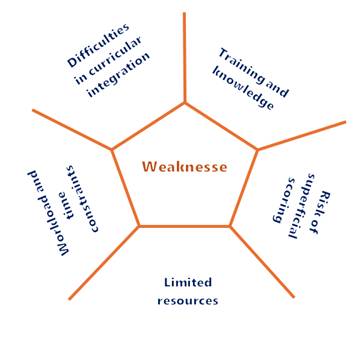
On the other hand, the perceived weaknesses include the following (see
Figure 2):
Figure 2
Perceived weaknesses
Note: Own elaboration (2025).
• Lack of training and knowledge: This
is perhaps the main barrier to effective implementation; it hinders the ability
to promote the development of logical-mathematical competencies in students (Gutiérrez, 2023). Other research reveals that teachers
do not address the central aspects of gamification because they have
weaknesses, which makes it difficult for them to generate changes in
pedagogical practices and apply gamification (Mosquera
and Londoño, 2022). Among those weaknesses found are
knowledge in design and implementation; studies (Wiggins,
2016) reveal that this is perhaps the
greatest barrier affecting teachers when designing and implementing
gamification, leading to low interest in carrying out didactic strategies in
the classroom. The same happens with little knowledge of resources, which causes
the applied gamified strategies to be inappropriate for the student's age or
cognitive level (Canhoto and Murphy, 2016). Another aspect to note is that
students must learn to apply their knowledge, to improve their
socio-communicative skills (Teichler, 2007).
• Difficulties in curricular integration: In
mathematics, difficulties persist such that "school failure and even
abandonment, it is necessary to recognize different didactic approaches that
invite motivation and focus the learner's attention on a syllabus linked to a
laborious comprehension" (Castro, 2021, p. 21). Precisely, this situation represents a challenge of implementing
gamification with learning objectives and the curriculum without it being
perceived as an isolated activity. Studies conducted in Colombia confirm that
the use of gamification as a methodological and didactic tool encourages
student participation and interest towards mathematics and enhances the
pedagogical praxis of the teacher in the classroom (Casalla and Mahecha, 2019). In turn, gamification is an innovative tool that enables and
facilitates the understanding of knowledge by students; as well as establishing
a challenge for the teacher to explore and integrate other methods and
pedagogical resources in their classes (Sánchez,
2018).
• Limited resources: Although the
"Colombia Aprende"
Program (2009) of the National Ministry of Education
has provided multiple technological tools for teachers and students for the
development of competencies in problem-solving, reasoning related to posing
hypotheses and problems, making conjectures, exploring examples using
self-learning, directed learning, or instruction. These efforts have not been
enough; the lack of access to technology, software, or specific materials can
hinder implementation. It is known that the insufficiency in the quantity of
devices to ensure that all students can interact with the gamified strategy is
related to the lack of computers or alternative technological devices like cell
phones or tablets (Piñeiro and Costa, 2015). But also, some of the free versions of certain online games or
gamified platforms for education and the decrease in internet access correspond
to obsolete technologies (Valencia and Orellana, 2019).
It is undeniable that in Colombia, as in
most Latin American and Caribbean countries, there are problems of coverage,
infrastructure, inadequate teacher training, as well as social and economic
gaps, inappropriate teaching strategies, inequality in internet access while
stratum six has 99.8%, for stratum one it is only 20.5%. 21.7 million have
internet access and 23.8% do not. In reality, those
most affected are poor families in neighborhoods and rural areas of the country
(Murcia, 2023; Tamayo et al. 2015).
Impact of gamification on academic
performance and motivation
Although the main
focus of this study is teacher knowledge and attitudes, the reviewed
works also provide evidence on the impact of gamification on students' academic
performance and motivation, aspects that directly influence teachers'
perception and disposition. Most empirical research reports a positive effect
of gamification on student motivation towards mathematics. It is found that the
application of gamification strategies produces significant advancement of most
students regarding the concept of fractions, terms, operations (addition,
subtraction, multiplication, and division) and the solution of mathematical
problems (Niampira,
2023).
It is worth noting that educational
experiences carried out in schools in Bogotá have developed intervention
strategies focused on video games/gamification with Scratch to strengthen
geometry learning (Hernández and Sarmiento, 2022). Other experiences have referred to the design of gamified virtual
learning environments with missions and challenges to teach fractions to
seventh-grade students. These situations generate changes in student attitudes
that translate into better academic performance and motivation to learn since
they contain elements typical of problem-solving, such as the assignment of a
development context and the structuring of phases of diagnosis, feedback, and
evaluation (Aldana, 2020).
Likewise, the implementation of a
virtual learning environment has generated positive impacts on students,
improving the competency of problem posing and solving, the
numerical-variational component, and the geometric-metric component; although
it is recognized that most students obtained a basic performance. Not all
students appropriated the steps to solve the proposed problems. The students
showed interest in the digital tools used in the virtual learning environment
and interacted without difficulties in each of the sections, and most solved the proposed activities in it. Similarly, the
use of gamified strategies in basic mathematics (such as addition, subtraction,
place value), incorporating elements such as missions, scores, and digital
rewards motivate students in the development of exercises like additions,
division (divisibility criteria), multiplication, and subtraction (Castillo, 2021). These and other works indicate that a
significant proportion of studies suggests that
gamification can improve learning outcomes in mathematics and incorporate
elements such as immediate feedback through playful interactions, which
facilitates the understanding of mathematical content by presenting it in a
clearer and more attractive way. On the other hand, gamification can foster a
collaborative learning environment, where students work together to overcome
challenges, which in turn improves their communication and problem-solving
skills. However, studies by García (2021) mention
that poor design planning or lack of teacher integration affects the result,
that is, the simple adoption of playful elements does not guarantee progress if
there is no pedagogical structure. In this sense, as affirmed by Rodríguez and Visbal (2022), changes are
required in the design of didactic strategies to gamified strategies that allow
understanding and enhancing knowledge in students. This reinforces the
importance of teacher training not only in the technical aspects of
gamification but also in its effective pedagogical application.
Challenges
and opportunities in the context of Bogotá
The identified challenges are similar to those of many educational institutions in the
city, where the availability of teacher training and technological resources is
often a critical factor. Just like insufficient teacher training, deficient
integration into the curriculum that limits the effectiveness of gamification,
the number of failures in mathematics, low motivation to learn (Castaño and Vargas, 2020), scarcity of technological resources
and connectivity difficulties, lack of teacher preparation to plan adequate
gamified experiences (Céspedes, 2022).
These presented situations represent the
opportunity to innovate from the pedagogical and technological implementation
in the classroom, provided that resources are provided
and teachers are adequately trained, which would represent the opportunity to
turn mathematics teachers into pioneers in the implementation of gamification,
creating models and good practices that benefit the entire educational community.
Collaboration between academia, educational authorities, and schools is
fundamental to developing training programs and resources that are relevant and
accessible to teachers in the city. However, to achieve these things,
investment in technological infrastructure and training programs is required to
ensure that all teachers, regardless of their location or the type of
institution they work in, have the opportunity to
acquire the necessary skills and knowledge to implement gamification
effectively.
Implications
for teacher training in Bogotá
The findings of this systematic review
have direct and significant implications for the design and implementation of
teacher training programs in Bogotá. It is evident that current training is not
sufficient to equip mathematics teachers with the knowledge and skills
necessary for the effective implementation of gamification. Professional
development programs must go beyond introductory workshops and offer more
in-depth courses that address:
• Theoretical foundations of gamification: The literature reviewed in this article makes it clear that not
only is there a wide diversity of definitions about what gamification is, but
there is no universal definition (Lozada and
Betancurt, 2015). Furthermore, the epistemological
bases of gamification lie in constructivism and connectivism. So, not only what
gamification is, but why it works, its psychological bases (intrinsic vs.
extrinsic motivation) and applied game design models in education.
• Pedagogical design of gamified experiences: Train teachers so they can design their own gamified activities, adapted to the specific learning objectives of the
mathematics curriculum and the characteristics of their students. This includes
the appropriate selection of mechanics, dynamics, and game components, as well
as the creation of attractive narratives and meaningful challenges. The design
of resources to strengthen students' numerical thinking by offering interactive
spaces strengthens students' numerical thinking (Becerra
et al., 2023). Design and implementation of a set of
activities oriented towards the gamification of mathematical challenges (Cárdenas and Chacón, 2023).
• Use of technological tools and platforms: Provide practical training in the use of software, applications,
and platforms that facilitate the implementation of gamification, considering
the diversity of resources available in educational institutions in Bogotá.
From this perspective, the National Ministry of Education conducted a workshop
in Colombia 4.0 in Bogotá, training 80 preschool, elementary, and middle school
teachers in the use of gamified tools available on the educational portal
Colombia Aprende (Ministry
of National Education, 2018). Furthermore, in some universities,
projects are being developed such as an innovative methodology to strengthen
teachers' technological competencies through immersive gamified experiences.
This project seeks to accompany the real pedagogical practice of teachers,
considering the institutional and community context, with the purpose of
promoting a solid and meaningful integration of emerging technologies (University of Santander, 2025).
• Evaluation of gamification: Teach
teachers how to evaluate the effectiveness of their gamified strategies, both
in terms of student motivation and engagement and academic performance in
mathematics. Although no specific studies were identified in Colombia that
teach teachers to evaluate the effectiveness of gamified strategies in
mathematics in terms of motivation, engagement, and performance, there is
research that can serve as a conceptual basis as already indicated in this
systematic review (Mera, 2016; Cáceres and Gómez, 2022; Cárdenas
and Chacón, 2023).
Furthermore, training must be continuous
and accompanied by classroom follow-up and support. The creation of communities
of practice among mathematics teachers implementing gamification can be an
effective strategy to foster collaborative learning, experience sharing, and
joint problem-solving. Universities and education secretariats in Bogotá have a
fundamental role in articulating these training programs, ensuring they are
relevant, accessible, and of high quality. But it is "necessary to continue
researching the attitudes of mathematics teachers regarding the potential of
game-based learning and gamification in teaching the subject" (Palacios and Cimas 2024, p. 3).
Recommendations
for educational policies and practice in Bogotá
To overcome the identified barriers and
maximize the potential of gamification in mathematics teaching in Bogotá, the
following recommendations are proposed, aimed at educational policymakers and
teaching practice:
·
Investment in
technological infrastructure: Ensure that
all educational institutions in Bogotá, especially public ones, have access to
adequate technological infrastructure (internet connectivity, devices,
software) that allows for the smooth implementation of gamified strategies.
Currently, there is an ongoing investment plan for improving infrastructure in
educational institutions. According to the National
Ministry of Education (2025, para. 1) "Educational
infrastructure not only supports the teaching-learning process, but also plays
a crucial role in creating an inclusive, motivating, and healthy environment
for all members of the educational community..." This is why for the
National Ministry of Education "The strategic line of regional convergence
of the National Development Plan 2022-2026 raises the need to promote
territorial equity and overcome gaps in access to education from the preschool
level to higher education" (Findeter, 2023).
·
Development of gamified
Open Educational Resources (OER): Promote
the creation of and access to gamified OER specifically designed for the
Colombian mathematics curriculum, which can be adapted and used by teachers.
This could include platforms, educational games, design templates, and
pedagogical guides.
·
Integration of
gamification into the teacher training curriculum: Incorporate gamification as a fundamental component in mathematics
teacher training programs, ensuring that future educators are prepared to
implement these methodologies from the start of their careers. Therefore, as Lozada and Betancur (2015, p. 99) state,
"the constant need to update educational methods must be considered to
improve the quality of education, which depends mainly on the content taught,
the needs of society, and coverage." From this point of view, the
integration of gamification is usually fundamental when it comes to
strengthening teacher training.
·
Promotion of
action-research in the classroom: Encourage
teachers themselves to conduct action-research in their classrooms to evaluate
the effectiveness of gamification in their specific contexts, generating
situated knowledge adapted to the realities of Bogotá.
The implementation of these
recommendations requires a coordinated and sustained effort from all actors
involved in Bogotá's educational system. By comprehensively addressing
knowledge, attitudes, and contextual conditions, the foundations can be laid for
a meaningful transformation in the teaching and learning of mathematics,
preparing students for the challenges of the 21st century and fostering a
positive attitude towards this fundamental discipline.
Discussion
The results obtained in this phase of
the research confirm a widely recognized trend in the reviewed studies and also
observed in the context of Bogotá: gamification continues to be valued by
mathematics teachers as a pedagogical strategy with high potential to
strengthen motivation, commitment, and meaningful understanding of content (Cáceres and Gómez, 2022). However, its real incorporation into
classrooms faces structural and formative challenges similar
to those identified in other Latin American contexts.
The evidence reveals that the knowledge
mathematics teachers possess about gamification tends to be limited and, in
many cases, superficial. As warned by Werbach and Hunter
(2012), this reduced understanding often
manifests in the adoption of basic mechanisms such as points, badges, or
leaderboards without a clear pedagogical intentionality. This finding, also
reported in Colombian research (Holguín et al.,
2020; Palacios and Cimas, 2024), confirms that the absence of
systematic training in gamification hinders the design of truly immersive
learning experiences that are coherent with curricular objectives.
Consequently, pedagogical innovation is frequently reduced to the superficial
incorporation of playful elements, without achieving a significant transformation
in mathematics teaching practices.
While teachers' attitudes towards
gamification are predominantly positive, resistances persist that reflect
tensions between innovation and pedagogical tradition. Some teachers express
concern about the possibility that gamification might trivialize content or
divert curricular focus, a perception also recorded by Cunza
et al. (2025). These reservations are explained, to a large extent, by the lack of a comprehensive
understanding of the methodology and the absence of institutional references
guiding its application. National research, such as that by Prada et al. (2021) and Cárdenas
and Chacón (2023), confirms that when gamification is
implemented with pedagogical intentionality, structured planning, and
curricular coherence, it generates significant changes in mathematics learning,
even in populations with diverse educational needs. Thus, teacher attitude
emerges not as an isolated factor, but as a key indicator of pedagogical
appropriation and commitment to transforming traditional practices.
Among the external factors affecting the
implementation of gamification, the availability of technological resources and
institutional support emerge as the most determining. The findings of this
review coincide with national reports that show the persistence of a
significant digital divide in the country, where only 51.9% of households have
stable internet access (Departamento Administrativo
Nacional de Estadística, 2020).
This inequality limits the possibility of integrating gamified tools in
classrooms, especially in Bogotá's public schools. Although recent studies
recognize advances in infrastructure and connectivity, structural and formative
deficiencies persist that restrict the scope of these strategies (Moya and
Díaz, 2024). In this way, teacher digital literacy and sustained investment in
educational infrastructure are consolidated as indispensable conditions for an
effective and equitable implementation of gamification in mathematics teaching.
Finally, the recent results of the Saber
11 tests (ICFES, 2025) offer an important context for interpreting the findings
of this research. The fact that the majority of
students are concentrated at a basic performance level (Level 3) and only a
small percentage reach advanced levels highlights the need to rethink the
pedagogical strategies used in mathematics teaching.
In this scenario, gamification emerges as a viable alternative to strengthen
critical thinking, problem-solving, and the application of knowledge in real
contexts, competencies characteristic of the higher performance levels.
Consequently, gamification, implemented in a planned manner and coherent with
curricular objectives, can contribute to transforming traditional teaching,
centered on mechanical repetition, into an active, motivating, and meaningful
learning experience.
The main finding of this study is that
teacher training constitutes the most determining axis for closing the gap
between the theoretical potential of gamification and its real application in
the classroom. It is not enough to introduce digital tools or resources; it is
essential for teachers to develop pedagogical competencies to design gamified
experiences coherent with curricular objectives and the characteristics of
their students. This requires a deep understanding of the psychological
foundations of motivation, the appropriate selection of game mechanics, the
didactic planning of challenges, and the ability to evaluate both learning
processes and results. Gamification, understood from this pedagogical
perspective, can become a strategy for educational transformation that enhances
critical thinking, problem-solving, and student autonomy in mathematics.
Secondly, it is possible that teachers'
positive attitudes towards gamification serve as a valuable starting point,
though insufficient on their own. For these attitudes to translate into
sustainable practices, an institutional environment that favors innovation is
required. This implies guaranteeing access to updated technological resources,
having time for the planning and design of gamified experiences, and promoting
educational leadership that recognizes and stimulates transformative
pedagogical initiatives. Without this structural and cultural scaffolding,
teachers' motivation risks being diluted in the face of practical barriers,
perpetuating the distance between innovative discourse and educational action.
Thirdly, the educational context of
Bogotá and by extension in Colombia poses structural challenges that condition
the implementation of gamification, among them the persistent digital divide
and the inequality of resources between public and private institutions. For
gamification to transcend isolated experiences and consolidate as a sustainable
strategy, public policies are required that guarantee equitable technological
infrastructure, accompanied by continuous teacher training processes.
Furthermore, it is essential to promote the development of open and gamified
educational resources, designed in coherence with the national curriculum and
accessible to the entire educational community. Only through this articulation
between pedagogical innovation, technological equity, and educational policy
will it be possible to effectively transform mathematics teaching in the
country.
Finally, gamification should not be
conceived as a total response to educational challenges, but as a complementary
strategy within an ecosystem of active methodologies oriented towards
meaningful learning. Its true value lies in its capacity to transform the way
students perceive mathematics, reducing anxiety and revealing the applicability
of this discipline in solving real problems. For the students of Bogotá, a
pedagogically well-founded gamification strategy represents a tangible
opportunity to develop critical thinking, creativity, and conceptual
understanding, competencies indispensable for facing the cognitive and social
challenges of the 21st century.
Conclusions
This systematic review on the knowledge
and attitudes of mathematics teachers in Bogotá towards gamification reveals a
central paradox: there is broad recognition of its potential to motivate
students and dynamize learning, but its practical and effective application is
still incipient and faces significant barriers.
The main conclusion is that teacher
training is the most determining factor for overcoming the gap between the
theoretical potential of gamification and its reality in the classroom.
Teachers require training that transcends the introduction to tools and focuses
on the pedagogical design of gamified experiences. This implies understanding
the psychological foundations of motivation, adjusting game mechanics with
curricular objectives in mathematics, and learning to evaluate both the process
and the results of learning in gamified environments.
Secondly, it is concluded that teachers'
positive attitudes are a valuable starting point, but insufficient. These must
be supported by favorable institutional conditions, which include access to
adequate technological resources, time allocated for planning and designing
these strategies, and educational leadership that values and promotes
pedagogical innovation. Without this scaffolding, teacher motivation can
decline in the face of practical difficulties.
Thirdly, the context of Bogotá, and by
extension of Colombia, imposes structural challenges such as the digital divide
and resource inequality between institutions. A successful implementation of
gamification on a large scale requires public policies that ensure equitable
technological infrastructure and the development of open gamified educational
resources, adapted to the national curriculum and accessible to all teachers.
Finally, gamification should not be seen
as a panacea, but as a powerful complementary strategy within a range of active
methodologies. Its true value lies in its capacity to transform the perception
of mathematics, reducing anxiety and demonstrating its relevance in
problem-solving contexts. For the students of Bogotá, mostly stuck in
procedural mathematical performance, well-oriented gamification represents a
tangible opportunity to develop critical thinking and a deeper conceptual
understanding, skills indispensable for the challenges of the 21st century.
Declaration
on the Use of Artificial Intelligence: The author of the present article declares that we have not used
Artificial Intelligence in its elaboration.
Privacy: Not applicable.
References
Acevedo, B. C. A. y Ortiz, R. E. J. (2020). Gamificación como estrategia de aprendizaje
para el mejoramiento de operaciones básicas y fundamentales en el área de
matemáticas en estudiantes de quinto primaria. Trabajo de grado presentado
como requisito parcial para optar al título de Magister en Tecnologías
Digitales Aplicadas a la Educación. Universidad de Santander.
https://repositorio.udes.edu.co/server/api/core/bitstreams/ec9e7d69-0f6a-40af-ae2f4b1d7bca5c49/content
Aldana, B. M. J. (2020). Misión Fracción: Un Entorno Virtual de Aprendizaje para la comprensión
de la relación parte todo. Trabajo para optar por el título de Especialista en
Educación en Tecnología. Universidad Distrital Francisco José de Caldas. https://repository.udistrital.edu.co/server/api/core/
bitstreams/fcdd81bb-0c46-4054-962f-f3896d542644/content
Almeida, C., Kalinowski, M., Uchoa, A. & Feijo, B. (2023). Negative Effects of Gamification in Education Software: Systematic Mapping and Practitioner Perceptions. Computer Science > Software Engi-neering. https://arxiv.org/abs/2305.08346?utm_source=chatgpt.com
Alsawaier, R. S. (2018). The effect of gamification on motivation and engagement. International Journal of Information and Learning Technology. 35(1), 56–79. https://doi.org/10.1108/IJILT-02-2017-0009
Ayala, P. J.K., Martínez, T. M. L. y Ortega, M.
M. del R. (2022). Estrategia Tecnológica
Basada en Gamificación para el Fortalecimiento del Proceso Evaluativo de la
asignatura de Física en Niños de 6 grado de la Institución Educativa Sorrento
Jornada Mañana. Trabajo de Grado presentado como requisito parcial para
optar al título de: Maestría en Educación. Universidad Cooperativa de Colombia.
https://repository.ucc.edu.co/server/api/core/bitstreams/ab906425-4e00-41f8-b4ef80d4a42b1d16/content
Baldeón de la Cruz, M.D., Holguín, Á, J. A. & Villa-Córdova, G.M. (2020). Provocation by Challenges: Optimizing Experience of Addressing Mathematical Tasks With High Cognitive Demand. Educare, 24(3), 1-20. https://doi.org/10.15359/ree.24-3.9
Banfield, J. y Wilkerson, B. (2014), Increasing Student Intrinsic Motivation And Self-Efficacy Through Gamification Pedagogy. Contemporary Issues in Education Research (CIER), 7(4), 291. DOI:10.19030/cier.v7i4.8843
Baydas, O., & Cicek, M. (2022). The examination of the gamification process in undergraduate education: a scale development study. Technology, Pedagogy and Education, pp. 1-19 DOI: 10.1080/1475939X.2019.1580609
Becerra,
J. Y. A., Mantilla, I. Montes, M. A. J. (2023). Recursos educativos digitales mediados por la
gamificación para mejorar el aprendizaje de las matemáticas en estudiantes de
primaria del Centro Educativo Gimnasio Pedagógico Marianito- Boyacá, Colombia. Dialogus, 11, pp. 69-87. https://re
vistas.umecit.edu.pa/index.php/dialogus/article/view/831/2009
Cáceres, G. Ma. v. y Gómez, B. D. (2022).
Actitudes del profesorado hacia la gamificación. Análisis y Modificación de Conducta, 48(1777), 145-157.
http://dx.doi.org/10.33776/amc.v48i177.7185
Calabor, M. S., Mora, A. y Moya, S. (2018).
Adquisición de competencias a través de juegos serios en el área contable: un
análisis empírico. Revista de
Contabilidad, 21(1), 38-47. doi:
https://doi.org/10.1016/j.rcsar.2016.11.001
Cáliz, O. S. Y., Cerón, C. L. V. Y Hernández,
S. G. A. (2024). La gamificación como
estrategia para fortalecer la enseñanza de las matemáticas en los estudiantes
del grado cuarto de la institución educativa agroindustrial los pastos
municipio de Ipiales. Informe de investigación para optar al título de
Licenciatura en Educación Básica primaria. Universidad Mariana. https://repositorio.umariana.edu.co/server/api/core/bitstreams/e2c0ea64c772-4f3c-a31e-985d594469cb/content
Canhoto, A.I. & Murphy, J. (2016). Learning from Simulation Design to Develop Better Experiential Learning Initiatives: An Integrative Approach. Journal of Marketing Education, 38(2), 98- 106. doi: https://doi.org/10.1177/0273475316643746
Cárdenas,
C. D. P. Chacón, G. G. A. (2023). Gamificación para la
Enseñanza y Aprendizaje de las Matemáticas basado en la Solución de Problemas
en Estudiantes con Necesidades Educativas Especiales (NEE). Góndola, Enseñanza y aprendizaje de las
ciencias, 18(3), 495-511. DOI: https://doi.org/10.14483/23464712.21036
Casallas Forero, L. F. y Mahecha Moreno, H. P.
(2019). Uso de estrategia didáctica
apoyada en la gamificación para el desarrollo de habilidades en el
planteamiento y resolución de problemas aritméticos, en instituciones
educativas rurales. Tesis de Maestría, Universidad Cooperativa de Colombia.
https://repository.ucc.edu.co/bitstream/20.500.12494/7044/1/2019_Gamificaci%C3%B 3n_Aula.docx.pdf.
Castaño, B. J. A. y Vargas, F. N. (2020). Evaluar el impacto de la gamificación como
estrategia para mejorar el aprendizaje en el área de matemática de grados 6 y 8
de secundaria. Trabajo de grado presentado como requisito parcial para
optar al título de Magister en Tecnologías Digitales Aplicadas a la Educación.
Universidad de Santander.
https://repositorio.udes.edu.co/entities/publication/e5dab1b4-e1ea-4f18-a8b4-d7bce50ba6e6
Castillo, L. A. L. (2021). Apropiación del Proceso de Resolución de Problemas Matemáticos en un Entorno Virtual de Aprendizaje. Trabajo de grado de Maestría en Educación en Tecnología. Universidad Distrital Francisco José de Caldas – RIUD-. https://repository.udistrital.edu.co/server/api/core/bitstreams/32133 ca2-86b4-4b7b-be11-92cd220068d4/content
Castro, B. L. G. (2021).
Gamificación como estrategia de enseñanza de las matemáticas en el nivel de
educación básica secundaria. Trabajo de grado. Universidad Nacional Abierta y a
Distancia. https://repository.unad.edu.co/bitstream/handle/10596/48611/Lgcastrob.pdf?sequence=3
Causado, E. r. E. y Pacheco, B. M. L. (2018). El aprendizaje basado en
videojuegos y la gamificación como estrategias para construir y vivir la
convivencia escolar. Revista CEDOTIC:
Revista de Ciencias de la Educación, Docencia, Investigación y tecnologías de
la Información, 3(1), 59-80. https://revis
tas.uniatlantico.edu.co/index.php/CEDOTIC/article/view/1971/2287
Cespedes, C. L. E. (2022). Características, oportunidades y retos de la gamificación para el
fortalecimiento de las prácticas pedagógicas en los procesos de lectura y
escritura en el grado primero de primaria de la Escuela Mary Villamizar, sede G
de la Institución Educativa Instituto Técnico Superior Industrial. Tesis
Doctoral. Universidad Autónoma de Bucaramanga. https://apolo.unab.edu.co/es/studentTheses/
características-oportunidades-y-retos-de-la-gamificación-para-el-
Claros, P. D. C., Millán, R. E. E. Gallego, T.
A. P. (2020). Uso de la realidad aumentada, gamificación y m-learning. Revista Facultad de Ingeniería, 29(54),
e12264. DOI: https://doi.org/10.19053/ 01211129.v29.n54.2020.12264
Criollo, Y. D. (2023). Una estrategia transversal gamificada desde la matemática recreativa,
en los estudiantes del Liceo Octavio paz de Bogotá. Trabajo de Grado. Universidad
de Cundinamarca.
https://funes.uniandes.edu.co/funes-documentos/una-estrategia-transversal-gamificada-desdela-matematica-recreativa-en-los-estudiantes-del-liceo-octavio-paz-debogota/?utm_source=chatgpt.com
Cunza, A. D. F., Requena, C. G., Saez, Z. N. S.
y Maquera, S. J. P. (2025). Diseño de una
escala de actitud hacia la gamificación en el aula universitaria: un estudio
piloto. Universidad, Ciencia y Tecnología, 29(127), 61-69.
https://doi.org/10.47460/uct.v29i127.963
De la Hoz, P. D. y Maestre, M. M. Y. (2020). La gamificación como estrategia para
fortalecer el valor cultural de los estudiantes de cuarto grado en el área de
sociales. Universidad Nacional Abierta y a Distancia. Diplomado Práctica e
Investigación Pedagógica. https://repository.unad.edu.co/jspui/bitstream/
10596/64789/4/mymaestrem.pdf
Departamento Administrativo Nacional de
Estadística (DANE) (2020), Boletín técnico. Educación formal (EDUC) 2019. https://www.dane.gov.co/files/investigaciones/boletines/educacion/ bol_EDUC_19.pdf
Deterding, S., Dixon, D., Khaled, R., & Nacke, L. (2011, September). From game design elements to gamefulness: Defining “gamification” [Conference session]. Proceedings of the 15th International Academic MindTrek Conference: Envisioning FutureMedia Environments (pp. 9–15). https://doi.org/10.1145/2181037.2181040
Dondio, P., Gusev, V. Racha, M. (2023). Do games reduce maths anxiety? A meta-analysis. Computers & Education, 194, 1–19. s://doi.org/10.1016/j.compedu.2022.104650
Elles Ardila, L. M., Gutiérrez A, D. (2021)
Fortalecimiento de las matemáticas usando la gamificación como estrategias de
enseñanza – aprendizaje a través de Tecnologías de la Información y la
Comunicación en educación básica secundaria. Interacción Revista digital de AIPO, 2(1), 7-16.
https://revista.aipo.es/index.php/INTERACCION/article/view/30
Elles, A. L. M. (2020). La gamificación como estrategia de enseñanza-aprendizaje fortaleciendo las competencias de las matemáticas a través de tecnologías de la información y la comunicación en educación básica secundaria. Trabajo de grado presentado como requisito parcial para optar al título de Magister en Tecnologías Digitales Aplicadas a la Educación. Universidad de Santander. https://repositorio.udes.edu.co/server/api/core/bitstreams/96c4a43e-7497-4b25-b865-73f0968ec9b2/content Eppmann, R., Bekk, M., & Klein, K. (2018). Gameful experience in gamification: Construction and validation of a gameful experience scale (GAMEX). International Journal of Research in Marketing, 35(1), 98-115. DOI: 10.1016/j.ijresmar.2018.03.002
Findeter (2023). ¿Cómo está Colombia en materia de Infraestructura educativa? https://www.findeter.gov.co/blog/venga-le-cuento/como-esta-colombia-en-materia-de-infraestructura-educativa
Flórez, M. M. (2024). Gamificando las
matemáticas: un estudio sobre la motivación y el desempeño escolar de alumnos
en el Colegio Oficial Nuestra Señora del Rosario. Universidad Nacional
Abierta y a Distancia.
https://repository.unad.edu.co/jspui/bitstream/10596/64590/1/mflorezmanr.pdf?utm_source=chatg
pt.com
García, G. (2025). Relectura de los procesos
socio políticos en la clase de matemáticas: dilemas éticos para proporcionar
equidad e inclusión a los estudiantes. Uniandes Colombia. https://ued.uniandes.edu.co/relectura-de-los-procesos-socio-politicos-en-la-clase-de-matematicas-dilemas-eticos-para-proporcionar-equidad-e-inclusion-a-los-estudiantes_pres
García, R. F. E. (2021). Evaluar el impacto de la gamificación como estrategia para mejorar el aprendizaje en el área de matemáticas de grados 6 y 8 de secundaria. Trabajo de grado presentado como requisito parcial para optar al título de Magister en Tecnologías Digitales Aplicadas a la Educación. https://repositorio.udes.edu.co/entities/publication/e5dab1b4-e1ea-4f18-a8b4-d7bce50 ba6e6/full?utm_source=chatgpt.com
García, S. R. (2025). Desigualdad educativa y
brecha digital: un análisis post-aceleración tecnológica. Revista Investigación & Praxis en CS Sociales, 4(1), 26–37.
https://doi.org/10.24054/ripcs.v4i1.4011
Guayara, M. G., Cortés, H. C. I., González, R.
J. N. y Sierra, B. D. M. (2018). La
gamificación como estrategia de enseñanza en el área de Ciencias Naturales.
Universidad de los Andes. https://repositorio.uniandes. edu.co/server/api/ core/bitstreams/0bee85fb-9763-4948-b384-f48452d8c609/content
Guillén, R. M. J. (2025). La gamificación en
educación: percepción docente, beneficios y retos en el aula. Revista Internacional Interdisciplinar De
Divulgación Científica, 3(1), 1-10.
https://riidici.com/index.php/home/article/view/43
Gutiérrez, L. (2023). Estrategias de enseñanza y aprendizaje de la
matemática basada en el uso de la TIC el desarrollo de competencias lógico
matemáticas en estudiantes de educación básica secundaria. Revista Digital de Investigación
y Postgrado, 4(7), 73-93.
https://redip.iesip.edu.ve/ojs/index.php/redip/article/view/86
Hamari, J., & Tuunanen, J. (2014). Player types: A meta-synthesis. Transactions of the Digital Games Research Association, 1(2), 29–53.
Hamari, J., Koivisto, J., & Sarsa, H. (2014, January). Does gamification work? A literature review of empirical studies on gamification [Conference session]. Proceedings of the 2014 47th Hawaii International Conference on System Sciences, January 6–9, 2014, Waikola, HI, USA (pp. 3025–3034). IEEE. https://doi.org/10.1109/HICSS.2014.377
Hanus, M. D. & Fox, J. (2015). Assessing the effects of gamification in the classroom: A longitudinal study on intrinsic motivation, social comparison, satisfaction, effort, and academic performance. Computers & Education, 80, 152–161
Hanus, M. D., & Fox, J. (2015). Assessing the effects of gamification in the classroom: A longitudinal study on intrinsic motivation, social comparison, satisfaction, effort, and academic performance. Computers & Education, 80, 152–161. https://doi.org/10.1016/j.compedu.2014.08.019
Hernández,
C. H. A. y Sarmiento, P. N. (2022). Geometry
Class. Programa Maestría: Comunicación y Educación en
la Cultura. Corporación
Universitaria Minuto de Dios. https://repository.uniminuto.
edu/server/api/core/bitstreams/4b618613-04bf-4510-8aac-125dc4aa5ffb/content
Hernández, L. (2017). Implementación de la Gamificación en el proceso de
enseñanza/aprendizaje en el uso de la tecnología a los estudiantes del colegio
Fray José María Arévalo del municipio de la playa de Belén. Ocaña:
Universidad Francisco Santander. https://www.google.com/url?sa=t&rct=j&q=&esrc=s&source=web&cd=&ved=2ahUKEwiYh4iG8oOPAxUKSDABHV6NM3wQFnoECBcQAQ&url=https%3A%2F%2Frepositorioinstitucional.ufpso.edu.co%2Fhandle%2F20.500.14167%2F1259&usg=AOvVaw1TI1Brk5wPBlSN9E4R7a39&opi=89978449
Högberg,
J., Hamari, J. & Wästlund, E. (2019). Gameful Experience Questionnaire
(GAMEFULQUEST): an instrument for measuring the perceived gamefulness of system
use. User Model User-Adap Inter 29, 619–660.
https://doi.org/10.1007/s11257-019-09223-w
Holguín, G. F. Y., Holguín, R. E. G. y García, M-N. A. (2020). Gamificación en la enseñanza de las matemáticas: una revisión sistemática. Telos, 22(1), 62-75. https://www.redalyc.org/journal/993/99362098012/html
Homer,
B. D., Raffaele, C., & Henderson, H. (2020). Games as playful learning:
Implications of developmental theory for game-based learning. In J. L. Plass,
R. E. Mayer, & B. D. Homer (Eds.), Handbook
of game-based learning (pp. 25–52). The MIT Press.
ICFES (2025). Examen Saber
11. Niveles
de desempeño: Prueba matemáticas. https://www.icfes.gov.co/wp-content/uploads/2024/11/Niveles-de-desempeno-MatematicasSaber-11.o-2022.pdf,
Instituto Colombiano para la Evaluación de la
Educación. (2025). Resultados
institucionales por sede jornada, Saber 11 2024 calendario A. Agregado 2024-2. https://www.icfes.gov.co/registro-descarga?archivo=https%3A%2F%2Fwww.icfes.gov.co%2Fwp-content%2Fuploads%2F2025%2F02%2FResultadosAgregados-2024-2.xlsx
Leó, F. A. y Cruz, J. O. (2021). Gamificación en matemáticas desde narrativas
transversales: una propuesta para grado 8°.
https://ued.uniandes.edu.co/gamificacion-en-matematicas-desde-narrativas-transversales-una-propuesta-para-grado-8_pres/?utm_source=chatgpt.com
Letwinsky, K. M. (2017). Examining the relationship between secondary mathematics teachers’ self-efficacy, attitudes, and use of technology to support communication and mathematics literacy. International Journal of Research in Education and Science (IJRES), 3(1), 56-66. https://files.eric.ed.gov/fulltext/EJ1126703.pdf
Lozada, A. C. y Betancur, G. S. (20185). La
gamificación en la educación superior: una revisión siste-
mática. Revista
IngenieríasUniversidad de Medellín,
16(31), 97-124. DOI:
https://doi.org/10.22395/rium.v16n31a5
Manzano, L. A., Aguilar, P. J. M., Rodríguez, m. J. & Ortiz, C. A. M. (2022). Gamification in initial teacher training to promote inclusive practices: A qualitative study. International Journal of Environmental Research and Public Health, 19(13), 8000. DOI: 10.3390/ijerph19138000
Martí, P. J., Seguí, M. D. & Seguí, M. E. (2016). Teachers’ Attitude towards and Actual Use of Gamification.
Procedia Social and Behavioral Sciences 228, 682 – 688. DOI:10.1016/j.sbspro.2016.07.104
Martins, C.,
& Giraffa, L.M.M.
(2016). Gamificação
nas práticas pedagógicas:
teorias, modelo e
vivências. Nuevas ideas en
informática educativa –
TISE, 11, 42-53.
https://www.tise.cl/volumen11/TISE2015/42-53.pdf
Mera, P. J. A. (2016). Gamificación una
estrategia de fortalecimiento en el aprendizaje de la ingeniería de sistemas,
experiencia significativa en la Universidad Cooperativa de Colombia sede
Popayán. Revista científica, 26,
1-11. chrome-extension://mhjfbmdgcfjbbpaeojofohoefgiehjai/index.html
Ministerio de Educación Nacional (2025). Infraestructura Educativa. https://www.mineducacion.gov.co/ 69 portal/micrositios-institucionales/Infraestructura-Educativa
Ministerio de Educación Nacional. (2018). Ministerio de Educación realizó taller de
Gamificación para docentes en ‘Colombia 4.0’. https://www.mineducacion.gov.co/portal/salaprensa/Noticias/
378143:Ministerio-de-Educacion-realizo-taller-de-Gamificacion-para-docentes-en-Colombia-4-0
Molina, L. D. F. (2024). A plicación de la Alfabetización Digital
Gamificada para Potenciar Habilidades Matemáticas en Primaria. Revista Tecnológica-Educativa
Docentes 2.0, 17(1), 412-422. https://doi.org/10.37843/rted.v17i1.501
Mosquera, D. M. I. y Londoño, P. L. D. (2021).
La gamificación como estrategia para la promoción del aprendizaje creativo en
estudiantes de básica primaria. Revista
Digital de Investigación y Postgrado, 3(5), 138-158.
https://doi.org/10.59654/7m6heg32
Moya, O. I. A. y Díaz, R. M. E. (2024). La
Gamificación en la Educación Básica Primaría en Colombia. Ciencia
Latina Revista
Científica Multidisciplinar, 8(5), 11376-11401. https://doi.org/10.37811/cl_rcm.v8i5.14519
Murcia, V. N. Y. (2023). Entornos virtuales de
aprendizaje con estrategias de gamificación para el fomento del pensamiento
crítico en ciencias sociales, Ciencia
Latina Revista Científica Multidisciplinar, 7(5), 5165-5188. https://ciencialatina.org/ index.php/cienciala/article/view/8118/12268
Niampira, C. Y. Z. (2023). El software JCLIC y la gamificación como herramientas didácticas para
el aprendizaje significativo de las fracciones y sus operaciones en el grado
cuarto de la I.E.D. Colegio
República de
México. Universidad
Pedagógica y Tecnológica de Colombia.
https://repositorio.uptc.edu.co/server/api/core/bitstreams/6266f738-e3f5-482b-9c6f.263ff9f10631/content
Organization
for Economic Cooperation and Development. (2019b). TALIS 2018 Results (Vol. 1). Teachers
and School Leaders as Lifelong Learners. Autor. https://doi.org/10.1787/1d0bc92a-en
Ortiz, M. G. J. y Guevara, v. c. F. (2021).
Gamificación en la enseñanza de Matemáticas. EPISTEME KOI-
NONIA: Revista
Electrónica de Ciencias de la Educación, Humanidades, Artes y Bellas Artes, 4(8), 164-184.
http://dx.doi.org/10.35381/e.k.v4i8.1351
Páez, Q. C., Infante, P. R., Chimbo, C. M. y Barragán, M. E. (2022). Educaplay: una
herramienta de gamificación para el rendimiento académico en la educación
virtual durante la pandemia covid-19. Revista
Cátedra, 5 (1), 32-47. https://doi.org/10.29166/catedra.v5i1.3391
Page, M. J., McKenzie, J. E., Bossuyt, P. M.,
Boutron, I., Hoffmann, T. C., Mulrow, C. D., Shamseer, L., Tetzlaff, J. M.,
Akl, E. A., Brennan, S. E., Chou, R., Glanville, J., Grimshaw, J. M.,
Hróbjartsson, A., Lalu, M. M., Li, T., Loder, E. W., Mayo, W. E., McDonald, S.,
McGuinness, L. A., Stewart, L. A., Thomas J, Tricco., A. C., Welch, V. A.,
Whiting, P., Moher, D. (2021). The PRISMA 2020
statement: an updated guideline for reporting systematic reviews. British Medical Journal, 372(71). doi:10.1136/bmj.n71.
Palacios, H.
F. J. y Cimas, J. G. (2024). Percepciones del profesorado de matemáticas sobre
la gamificación: Conocimiento, formación y utilidad. Bolema, Rio Claro (SP), 38, 1-22. DOI:
http://dx.doi.org/10.1590/1980-4415v38a230080
Parra, G. M. E. & Segura, R A. (2019).
Producción científica sobre gamificación en educación: un análisis
cienciométrico. Revista de Educación, 386,
113-135. DOI: 10.4438/1988-592X-RE-2019-386-429
Parra, G. M. E., Segura, R. A. & Marín, M.
J. A. (2019). Gamification in education: A systematic
review. Revista de Educación, 386, 169-192. DOI: 10.4438/1988-
592X-RE-2019-386-427
Pérez, P. P.
M. (2025). Gamificación como estrategia
para la enseñanza de Matemática de los estudiantes del sexto año de educación
básica de la escuela “Eugenio de Santa Cruz y Espejo D07”. Magíster en
Educación y Tecnologías de la Información y Comunicación, Mención en Formación
del Profesorado. Universidad Andina Simón Bolívar. https://repositorio.uasb.edu.ec/bitstream/10644/10401/1/T4520METIC-Perez-Gamificacion.pdf
Perochena, G. P., Cárdenas, L. J. A., Mosuera,
G. I. Y Guerrero, B. E. (2020). Autoeficacia del profesorado de matemáticas
colombiano en relación con su autopercepción laboral y con otras variables. Universitas Psychologica, 19, 1-15. DOI:
https://doi.org/10.11144/Javeriana.upsy19.apmc
Piñeiro, O. T. y Costa, S. C. (2015). ARG
(juegos de realidad alternativa). Contribuciones, limitaciones y
potencialidades para la docencia universitaria]. Comunicar, 44, 141-148. https://doi.org/10.3916/C44-2015-15
Ponce. J. Z. (2024). Diseño de estrategias
basadas en la gamificación integradas al currículo para el fortalecimiento de
las practicas pedagógicas de los docentes de básica primaria de las
Instituciones Educativas rurales Zona Bananera -Magdalena-Colombia. Ciencia
Latina: Revista Científica Multidisciplinar, 8(6), 10705-10719. DOI:
https://doi.org/10.37811/cl_rcm.v9i1.15796
Prada, N. R., Hernández, S. C. A. Avendaño, C.
W. R. (2021). Gamificación y evaluación formativa en la asignatura de
matemática a través de herramienta web 2.0. Red iberoamericana de pedagogía,
41-359. https://editorial.redipe.org/index.php/1/catalog/download/8/13/297?inline=1
Quimí, C. K. J. y Laínez, Q. G. A. (2024).
Percepción docente: gamificación en la enseñanza de las matemáticas en
educación básica superior. Ciencia y Educación, pp. 119-134.
https://cienciayeducacion.com/index.php/journal/article/download/zenodo.12624567/546?inline=1&utm_source=chatgpt.com
Rodríguez, D. Y. J. y Visbal, C. G. (2022). Estrategias Didácticas Basadas en
la Gamificación para el Fortalecimiento de la Competencia Uso Comprensivo del
Conocimiento Científico. Trabajo presentado como requisito para optar al título
de Magíster en Educación. Universidad de la Costa. Estrategias Didácticas
Basadas en la Gamificación para el Fortalecimiento de la Competencia Uso
Comprensivo del Conocimiento Científico.
Rojas, M. de Huali, G. y Gallesse, P., N.
(2025). Reflexiones sobre Percepciones de Docentes de Ingeniería acerca de sus
Competencias Digitales en Pandemia. Revista
Tecnológica-Educativa Docentes 2.0, 18(1), 189- 206.
https://doi.org/10.37843/rted.v18i1.606
Rubiano, L. C. F. (2023). Integración de la gamificación en la enseñanza de la suma de números racionales en grado séptimo. Trabajo Para optar al grado de Magíster en Educación. Fundación Universitaria los Libertadores. https://repository.libertadores.edu.co/server/api/core/bitstreams/29b6be92-c9bf-4243-9636-cebae373aa86/content
Sánchez Medina, J. J. (2018). La gamificación a través de la plataforma
Smartick para mejorar el rendimiento académico en matemáticas en estudiantes de
la I.E.D. Tercera Mixta de Fundación – Magdalena. Tesis de Maestría,
Universidad de la Costa. https://repositorio.cuc.edu.co/handle/11323/67.
Santamaría, F (2011). Gamificación y
motivación. http://fernandosantamaria.com/blog/tag/gamification/
Sarmiento, P. L. (2020). La gamificación como estrategia de enseñanza creativa de la
potenciación en séptimo grado. Trabajo
de grado como requisito para optar al título de licenciado en matemáticas.
Universidad del Atlántico.
https://funes.uniandes.edu.co/funes-documentos/la-gamificacion-comoestrategia-de-ensenanza-creativa-de-la-potenciacion-en-septimo-grado/?utm_source=chatgpt.com
Scolari, C.A. (2013). Homo videoludens 2.0. De Pacman a la gamification. Colección Transmedia
XXI, Laboratori de Mitjans Interactius: Universitat de Barcelona, España.
Seaborn, K., & Fels, D. I. (2015). Gamification in theory and action: A survey. International Journal of Human-Computer Studies, 74, 14–31. https://www.google.com/url?sa=t&rct=j&q=&esrc=s&source
=web&cd=&cad=rja&uact=8&ved=2ahUKEwjShaCLrZePAxXzRzABHainOGAQFnoECAkQAQ&url =https%3A%2F%2Fwww.sciencedirect.com%2Fscience%2Farticle%2Fpii%2FS1071581914001256&us g=AOvVaw3XnwvAX19DIGfAVObA4fRZ&opi=89978449
Su, C.-H., & Cheng, C.-H. (2015). A mobile gamification learning system for improving the learning motivation and achievements. Journal of Computer Assisted Learning, 31(3), 268–286.
Tafur,
M. F. J., Almao, M. V. A. y Zambrano, C. L. (2023). Conocimiento sobre la gamificación como técnica
para reforzar el aprendizaje en la educación superior. 593 Digital Publischer CEIT, 8(3), 209-218.
doi.org/10.33386/593dp.2023.3.1628
Tamayo A., O.; Zona, R.; Loaiza Z., Yasaldez,
E. (2015). El pensamiento crítico en la
educación. Algunas categorías centrales en su estudio. Revista Latinoamericana de Estudios Educativos (Colombia), 11(2),
111-133. https://repositorio.ucaldas.edu.co/handle/ucaldas/16473
Teichler, U (2007). Does Higher Education Matter? Lessons from a Comparative Graduate Survey. European Journal of Education, 42, 11-34. (DOI: http://doi.org/dm7k2j).
Teixes, F. (2014). Gamification: fundamentals and applications. UOC
Toda, A.M., Palomino, P.T., Oliveira, W., Rodrigues, L., Klock, A.C.T., Gasparini, I., Cristea, A.I., & Isotani, S. (2019b). How to Gamify Learning Systems? An Experience Report Using the Design Sprint Method and a Taxonomy for Gamification Elements in Education. Journal of Educational Technology & Society, 22(3), 47–60, https://www.jstor.org/stable/26896709
Universidad de Santander (2025). Propuesta Practicar: Prácticas Pedagógicas Mediadas por Gamificación Inmersiva para el Fortalecimiento de Competencias Tecnológicas en Docentes de Instituciones Colombianas. https://udes.edu.co/campus-virtual-udes/investigacion/proyectos-de-investigacion/practicar-gamificacion-inmersiva-para-fortalecer-competencias-tic-docentes
Valencia, Q. L. I. y Orellana, V. D. (2019). Barreras en la implementación de la gamificación en educación superior: revisión de literatura. In Crescendo, 10(3), 635-650. https://www.researchgate.net/publication/341709748
Werbach, K., & Hunter, D. (2012). For the win: How game thinking can revolutionize your business. Wharton Digital Press. https://fliphtml5.com/ndhs/wtqf/basic
Wiggins, B. E. (2016). An overview and study on the use of games, simulations, and gamification in higher education. International Journal of Game-Based Learning (IJGBL), 6(1), 18-29. https://doi.org/10.4018/IJGBL.2016010102
Fecha de recepción del artículo: 27 de junio de 2025
Fecha de aceptación del artículo: 1 de agosto de 2025
Fecha de aprobación para maquetación: 15 de agosto de 2025.
Fecha de publicación: 10 de enero de 2026