Introduction
In recent decades, the social, cultural, technological, and political changes affecting contemporary educational systems have produced a transformation in the practice of the teaching profession. In this sense, the practice of teaching must remain in a tension between the educator's being and ought to be, which refers to the distance existing in the profession, in terms of experience, vocation, and ethical consciousness, and the assumption of the normative, administrative, and technical demands derived from educational policies and school management models (Tenti, 2005). The distance between the different dimensions that constitute the teaching profession is not an individual problem; at best, it is a collective and structural problem of pedagogy, of teaching practice, and of the ethics of education.
In the Ibero-American context, numerous studies consider that teacher identity is not a static condition or an attribute definitively acquired during initial training. Instead, it presents itself as a dynamic, historical, and relational construct, shaped at the intersection of the subject, the institutional context, and pedagogical practice (García, 2022). From this perspective, teacher identity is a process understood as the continuous interpretation, throughout the life cycle, of a series of autobiographical elements, values, knowledge, demands, intersubjective and intrasubjective factors, and social aspects. In this sense, the growing normative and prescriptive emphasis on the ought to be constitutes a regulatory horizon that impacts pedagogical practice. Nevertheless, and frequently, it operates decontextualized and removed from classroom realities and the educator's subjectivity (García, 2024).
The gap between what is and what ought to be has brought to the surface some relevant ethical tensions in teaching practice, especially when institutional demands favor accountability, curricular standardization, and administrative control, to the detriment of more formative, reflective, and human educational processes (De la Hoz Cantillo, 2023; Flores et al., 2022). In this context, teaching runs the risk of being reduced to a purely technical and instrumental function, stripped of its ethical, political, and ontological dimensions. In this regard, and according to Freire (2019), pedagogical practice must be seen as a non-neutral and situational act that demands an ethical and political positioning concerning the world, knowledge, and the other.
From this perspective, teacher identity and praxis must be analyzed from a viewpoint that transcends technicist or positivist approaches. Philosophical hermeneutics, as in the tradition of Gadamer (2018) and Ricoeur (2018), constructs a framework that, by defining understanding as a situated, interpretive process measured in terms of language, historicity, and experience, proves appropriate. Thus, pedagogical practice is a positional interpretive practice in which the teacher re-signifies their role, responsibilities, and ethical decisions in and for the educational and social context.
The responsibility of an educator centers on ethics when one considers that educating means relating to the other. For Levinas (2019) and the ethics of alterity, the educational act is a commitment to the face of the other, a commitment that calls for a response from the educator. Therefore, it is an act that requires from them care, recognition, and commitment. Such understanding finds an echo in Morin (2020), when he states that education must be oriented towards the integral development of the human person, in a complex and inseparable manner, constructing knowledge, ethics, and affectivity. Consequently, it is teaching practice that constitutes the convergence point of personal identity, ethics, and pedagogy.
This article aims to analyze the current tension between the real and ideal roles of the teacher in contemporary education, through a hermeneutic perspective that integrates ontological, ethical, and pedagogical dimensions. The intention is to conduct a comprehensive investigation of teacher otherness, considering the professional experience of educators, and the ethics, ontology, and pedagogy that emerge from such practices.
The research design was developed under a qualitative hermeneutic approach, utilizing semi-structured interviews, as well as reflective observation, participation, and documentary analysis. The research was conducted in public education in Colombia and included practicing educators and teacher trainers. The analysis was divided into three phases corresponding to pre-understanding, interpretation, and the fusion of horizons, in relation to Gadamer's (2018) hermeneutic circle. Consequently, the emergence of interpretive categories in teacher identity, professional ethics, and pedagogical praxis was facilitated.
As a result, the study proposes a model termed the Hermeneutic Triangle of Being, Ought to Be, and Teaching Practice, which offers the possibility of understanding teaching as a praxis in which identities, ethics, and pedagogical action are integrated in a dialectically articulated manner. This contribution to reflection on teacher training and practice aims precisely to restore the humanistic and ethical perspective that must accompany education, as it confronts the challenges inherent in contemporary education.
Methodology
The research was conducted from a qualitative hermeneutic approach, aimed at understanding the ethical, ontological, and pedagogical meanings that configure the being and ought to be of the educator within the contemporary educational scenario. This approach is based on the assumption that educational reality cannot be reduced to objectively observable and measurable facts, but must be understood and interpreted based on the experiences, narratives, and understandings that teachers have constructed regarding their professional practice. In line with philosophical hermeneutics, understanding was taken as a situated, historical, and relational interpretive process in which a fusion of horizons occurs between the researcher and the educational phenomenon (Gadamer, 2018).
The study was conducted with active teachers and teacher trainers affiliated with public institutions of primary, secondary, and higher education in Colombia. Participants were selected through purposive sampling, prioritizing criteria such as professional training, teaching experience, and reflective disposition regarding educational practice, as proposed by Patton (2015). Participants were viewed as hermeneutic subjects, considering them as agents capable of constructing meaningful interpretations of their teaching practice, and appreciated from their ethical, professional, and personal experience.
The interviews and documentary analysis were accompanied by reflective participant observation. The tension between teachers' professional identity and institutional expectations was addressed through the interviews. Teaching praxis was accompanied and understood through reflective participant observation, in didactic proposals, in training decisions, and in the ethical dilemmas that arise in the daily exercise of teaching. Document analysis focused on educational policies, professional ethics codes, teacher training programs, and academic literature, to situate participants' narratives within broader institutional and regulatory contexts.
Pre-understanding, interpretation, and the fusion of horizons constituted the stages of the information processing practice, based on Gadamer's (2018) hermeneutic circle. In pre-understanding, the researcher identifies the hypotheses and positions, in this case, of the researcher, towards the phenomenon under study. Then, in the interpretive phase, analytical readings and dialogical readings of narratives and documents were carried out, allowing for the construction of meaning and the discovery of categories related to teacher identity, ethics, and teaching practice.
Throughout the research, the researcher executed a practice of reflexivity, systematizing in a journal the perceptions, intuitions, and ethical dilemmas that arose when interpreting the information. This practice is considered an exercise in epistemological transparency, which recognizes the researcher's role in executing data interpretation. In this sense, the researcher considers research objectivity not as a neutral stance, but as a practice of self-documentation of the reflective and monitoring role that the researcher has over the interpretations they make, as well as their critical perspective.
The ethical aspects of the study conformed to the regulations of the American Educational Research Association (AERA, 2020) insofar as they ensured informed consent, protection of identity, and the right to non-participation of the teachers. Additionally, the research focused on Levinas's (2019) ethics of encounter, who considers the connection with research participants as a responsibility. This responsibility refers to respect for and recognition of the dignity of the participants' voices as ethical and reflective subjects.
Results and discussion
The hermeneutic analysis of teacher narratives and institutional documents allowed for an understanding of the educator's being and becoming within the framework of their insertion into concrete educational realities. From the interpretation process—developed in the phases of pre-understanding, interpretation, and fusion of horizons—three interpretive categories emerged that structure the core of teaching thought in the current context: (a) the ontological self-understanding of the teacher; (b) the ethical tension between the vocational calling and institutional regulation; and (c) pedagogical praxis as a space for mediation and reconciliation. These categories were articulated in an interpretive model proposed in this study, termed the Hermeneutic triangle of being, ought to be, and teaching praxis.
Figure 1
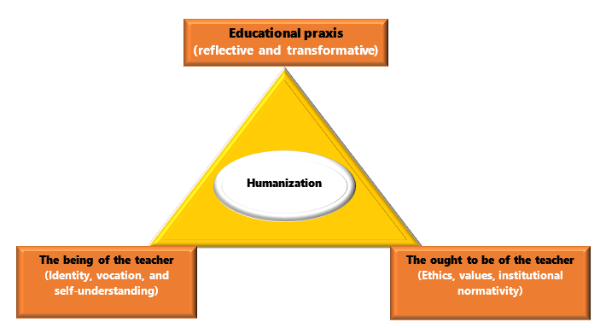
The hermeneutic triangle of being, ought to be, and teaching praxis
Note: Own elaboration (2026).
Category: The being of the teacher (identity, vocation, and self-understanding).
Figure 1 presents the Hermeneutic triangle of being, ought to be, and teaching praxis as an interpretive model that synthesizes the constitutive tensions of professional teacher identity in the current context. This model is elaborated from the hermeneutic analysis of teachers' narratives and, therefore, explains that identity is not conformed as a static category, or as a result, but is configured as a dynamic process of mediation where the ontological dimension of the teacher's being, the normative demands of the ought to be, and educational practice overlap and are actualized.
The vertex of teacher being refers to the ontological and vocational dimension of professional practice, which is associated with self-understanding, ethical convictions, responsibility, and the meaning that the teacher attributes to their work. This dimension, as Ricoeur (2006) points out when speaking of a narrative identity, is constructed and reconfigured throughout the professional trajectory, in dialogue with narratives and experiences. In this way, teacher being is not merely performing a functional role, but rather, it is a way of being in the educational world.
At the other vertex of the triangle lies the duty to teach, which encompasses all instructional guidelines, teaching policies, curricular frameworks, and institutional expectations that establish parameters for teachers' professional practice. This dimension attempts to provide, at least, some level of rationality which, however, is hostile to educational autonomy and the uniqueness of school contexts. As Hargreaves (2003) notes, teachers' ever-increasing workload and the standardization of teaching lead to what is known as simplification. This is especially true when the 'duty' is imposed uncritically without considering the teacher's experience and professional judgment.
Teaching practice, positioned at the third vertex, is that space where 'being' and 'doing' are located, confronted, and resignified in relation to one another. From the perspective of philosophical hermeneutics, practice is more than mechanical execution. It is an interpretive action that requires a certain intellectual work, and it is an action that entails responsibility and ethical decision-making in particular situations (Gadamer, 2018). It is in practice where the teacher balances regulatory needs and the actual needs of students, and it is here that pedagogical actions emerge in a situated manner, which do not necessarily conform to institutional edicts.
It should be clarified that, within this model, the triangular configuration does not mean that each dimension functions in isolation. Instead, the tension described by each dimension is fundamental in the construction of educational identity and reinforces the conflict between 'is' and 'ought to be' as a structural condition of the teaching profession. From the perspective of the ethics of alterity, this tension is aggravated in the relationship with the other —the student— whose very presence summons the teacher to respond, beyond the norm, in a responsible and contextualized manner (Levinas, 2019).
Figure 1 does not intend to offer a closed explanatory framework, but rather an interpretive distribution that allows us to glimpse some of the complex facets that configure teacher identity in the contemporary context. In this sense, educational practice is perceived as a space for ethical and pedagogical mediation in which professional identity is constructed and negotiated permanently, in the dynamic interrelation between teacher self-understanding, normative demands, and the situated exercise of education.
Category: The ethical responsibilities of teachers as a matter of routine.
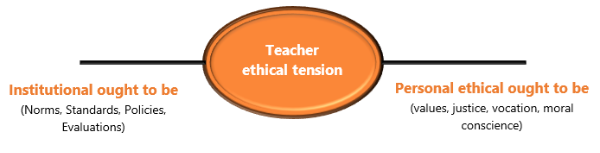
In a second category, the tension in educational policies between 'what ought to be' and 'what is' emerged as a kind of ethical self-commitment. Teachers argued that institutional policies tend to focus on the centrality of imposing rigorous criteria on the functionality of teaching, its evaluation, and the productivity of teaching, which in turn strips away the human dimension of teaching and learning. Along these same lines, Flores et al. (2022) document that most educators consider professional ethics to be one of the most contradictory areas between ideality and practice, where norms and reality intertwine, and where administrative moral demands and unidimensional administrative ethical values intersect. De la Hoz (2023) states that some participants expressed the existence of a 'duty' that was defined horizontally, and was used, by analogy, to cardinal axes. 'Ethics is not taught, it is lived' is a phrase that many used and may lead to Freire's (2019) vision of education as a profoundly moral act. From De la Hoz (2023) because the ethical praxis of teaching must be situated, in this case, in the social and cultural context of the educational act. Complementarily, Baca et al. (2023) and their reflections on the new ethics of digital teaching and social responsibility regarding information, privacy, authorship, and digital property.
The analytical approach allows us to conclude that the enunciation that the teacher can make in terms of futurism cannot be anchored in a system of bureaucratic imposition. Moreover, it is a system of imposing action possibilities. For Gadamer (2018), this would be an ethics of understanding, thus named from the subject's openness to the encounter with the other. From this point of view, to understand is to sit at the table of dialogue, actively engaging in interaction and abandoning the imposition of closed or definitive truths. This explains why teacher training must appeal to ethics and philosophy and, in the case of teaching, to love and passion.
Figure 2
Tensions of the teacher's ought to be
Note: Own elaboration (2026).
Category: Pedagogical praxis (Space of reconciliation)
The third emerging category is the pedagogy of praxis that originates from the territory, conceptualized as the space where the teacher's being and ought to be intersect in action. The reflections indicated that a significant number of teachers, in their ethical dilemmas, choose to humanize the teaching process in their instructional strategies. One of the teachers expressed, "When I listen to students, I learn to be a better teacher. The ought to be comes from the classroom, not from the book." This expression captures the meaning of Freire (2019) when he maintains that teaching is not simply transferring knowledge, but creating conditions for students to appropriate meaning.
Mora (2024) argues that critical pedagogy materializes in teaching processes when teachers, through reflective and reasoned exercise, assume an ethical stance toward social injustices. Complementarily, Castillo et al. (2023) point out that the ethical leadership of teachers contributes to the construction of students' professional ethos, transforming the classroom into a space for moral formation.
The results indicated areas that led to positive constructions of the pedagogy of practice as an exercise in pedagogy, not as mere transmission of input, knowledge, or values. They exemplify transformative practice that articulates the ideal with the real, thought with action, being with ought to be. This resonates with Morin's (2020) elaboration describing education as a complex framework where knowledge, ethics, and affectivity intertwine to build liberated and responsible citizens.
Figure 3
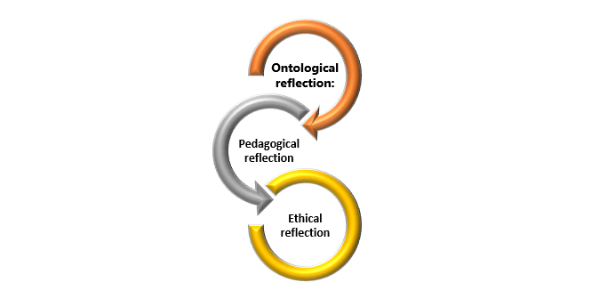
The reflective spiral of teaching praxis.
Note: Own elaboration (2026).
Contemporary educational practice can and should be recognized as a transformative and reconstructive process of the teacher's integrality. It is not merely an exercise of profession; it is also an exercise of meaning, where the teacher's identity is conjugated with the identity of being. This provokes a dialectical tension that articulates the meaning of educational practice. Along these lines, the educator does not teach from a norm, but from a consciousness that appropriates them. This transforms their praxis into a reflective experience where the pedagogical, the ethical, and the ontological are articulated in the same task which, fundamentally, is no longer only in the classroom. It is the humanization of education.
From the perspective of Levinas (2019), the origin of all moral action is responsibility toward the other. In this way, and within the realm of education, it is a matter of ethical recognition of otherness in the pedagogical relationship. To educate, in this sense, means to care, to listen, and to accompany with dignity, knowing that each encounter with the student is an encounter with the face of the other, which poses a moral demand. Understood in this way, the teacher no longer conceives of themselves as a mere transmitter of content, or as an executor of institutional policies; they perceive themselves as an ethical subject who is in contact with the profound meaning of their pedagogical work in contexts marked by fragmentation and dehumanization. Their work is not limited to complying with pre-established standards; moreover, it is oriented toward the construction of a culture of ethical reflection, where teaching is conceived as a situated, committed, and transformative act in the here and now of the educational experience.
Under such circumstances, teaching practices could be thought of as a hermeneutic praxis, which implies a more distanced dialogue between what institutional frameworks, norms, and consciousness do. Only in this double ethical and creative tension can transformative teaching emerge that illuminates the meaning that each individual grants to the knowledge we construct in school. A teaching capable of integrating the technical and the sensitive, the norm and the human, and education and its true essence.
Conclusions
The interpretive analysis allows us to recognize that today's teacher faces existential crossroads where being and ought to be, in this case, are neither abstract nor philosophical; they are lived in the paradoxes of professional practice. The analysis illuminates that being a teacher means being in a continuous and repetitive process of enormous difficulty. Of forging and desperately seeking self-understandings, identity constructions within a constellation of vocation, a constellation of experiences, and a strong ethical commitment to the other. It is not a given being. It is a being that relates—to students, to knowledge, and to the world.
The being, in this case, must be more than a list of institutional rules and prescriptions. It is an ethical horizon aimed at structuring educational practice, in terms of equity, responsibility, and alignment, as far as the ethical is concerned. The more a teacher incorporates this ethical 'being' into their professional role, the more ethics, as a protos position, transforms into something almost instinctive. This sense of teaching becomes acts that clothe the rule in a lived, human experience.
The idea of tension between two poles—identity and aspiration—becomes clearer and more significant. In this configuration, the pedagogy of praxis sees the potential to invert tension and convert it into growth. Teaching, in this configuration, is more than merely delivering content. Teaching, in this configuration, is a multifaceted experience that goes beyond the creation of meaning and includes the three primary domains of learning—cognitive, psychomotor, and affective. Education, in this case, is the opportunity to engage in intentional action that sustains the intrinsic value of all parties in the interaction. Education, in this case, is the opportunity to engage in intentional action that, at every moment, sustains the intrinsic value of all parties in the interaction.
The previous notion situates the teacher as a philosophical subject of discourse about education. In this notion, the teacher can reflect on existential questions about their being in the world and whether their teaching is consistent with their lived realities. Questions about the truth of their words and the weight of their actions. In this, the teacher is justified in constructing an ethics of care, presence, and consideration toward the other. In this, the teacher can participate in an ontological pedagogy of the person, which means that teaching is, at least, about the capacity to recognize the other and for the other to recognize the other.
The results of this study indicate that one of the most important challenges facing education today does not consist of the application of new technologies or the measurement of learning outcomes, but rather relates to the need to reconfigure the human dimension of educational activity. From this perspective, the school remains the place of dialogue, reflection, and integrality, where the teacher's voice regains relevance as pedagogical and ethical mediation, and not as a mere instructional resource. From the assumptions set forth, the teacher's being and doing are not assumed as dissociated dimensions, but as interdependent instances in the articulation between ethos and praxis, reason and affect in educational practice.
Teaching, understood thus, is an act of responsibility, an act of overflowing the dehumanization of education, and an act of invitation to commitment to a way of thinking, feeling, and acting in an integrated manner. The phenomenon of teaching in the sphere of being and doing reveals the teacher, first and foremost, as a humanizing being, a giver of meaning, and a beacon in the darkness. Teaching, of all things, educes a certain consciousness that, when Philosophy penetrates the civilizational fabric, elevates the function of teaching to the level of a true vocation, a vocation for justice, for the transformation of the human person.
Privacy: Not applicable.
Declaration on the use of artificial intelligence: The author of this article declares that no artificial intelligence has been used in its preparation..
References
AERA. (2020). Ethical Standards of the American Educational Research Association. https://www.aera.net/About-AERA/AERA-Rules-Policies
Baca, C. W. A., Jiménez, Cedeño, J. A., Bedón, Paredes, S. R., Moreno, V.L. G. and Macías Suárez, M. J. (2025). La ética del docente en la era digital: privacidad, derechos de autor y uso responsable de la tecnología. Ciencia Latina Revista Científica Multidisciplinar, 9(1), 2191–2209. https://ciencialatina.org/index.php/cienciala/article/view/15989
Castillo, G. A., Pastrán, C.F., and Mendoza, M. J. (2023). Liderazgo ético del docente universitario en la formación del ethos del futuro profesional. Revista Andina de Educación, 7(1), 1–14. https://revistas.uasb.edu.ec/index.php/ree/article/view/1554
De la Hoz, C. N. R. (2023). Competencias docentes para fomentar una praxis contextualizada de la educación ética y valores morales. Revista Latinoamericana Ogmios, 1(7), 15–29. https://idicap.com/ojs/index.php/ogmios/article/view/184
Flores, L.F. A., Valenzuela, C. J. C. and Campos Dávila, J. E. (2022). Ética y docencia en la educación universitaria en el periodo 2017–2022: una revisión sistemática. Ciencia Latina Revista Científica Multidisciplinar, 7(1), 4604. https://ciencialatina.org/index.php/cienciala/article/view/4604
Freire, P. (2019). Pedagogía de la autonomía: Saberes necesarios para la práctica educativa. Siglo XXI Editores.
Gadamer, H. G. (2018). Verdad y método. Salamanca: Sígueme.
García, R. J. (2022). Construcción de la primera identidad profesional del profesorado español de secundaria durante su formación inicial. Revista Mexicana de Investigación Educativa, 27(94), 105–125. https://www.redalyc.org/articulo.oa?id=14072628004
García, C. J. (2024). Narrativas docentes: tensiones entre discurso y práctica: Teacher narratives: tensions between discourse and practice. LATAM Revista Latinoamericana De Ciencias Sociales Y Humanidades, 5(6), 1489 – 1358. https://doi.org/10.56712/latam.v5i6.3087
Gómez, T. F. H., Castro, G. G. Y., & Romero, N. W. H. (2022). Caracterización de la identidad profesional del docente universitario. Espiral – Estudios sobre Estado y Sociedad, 12(1). https://doi.org/10.15332/erdi.v12i1.2884
Herrera, E. K. C., Gonzales, S. F., García, M. G. D. P. and Ponce, Y. D. L. P. (2022). Identidad profesional y vocación docente. Episteme Koinonia, 5(10), 113–132. https://fundacionkoinonia.com.ve/ojs/index.php/epistemekoinonia/article/view/2531
Levinas, E. (2019). Totalidad e infinito. Sígueme.
Mora, R. R. F. (2024). Pedagogía crítica y la educación actual. Revista Ciencias y Humanidades, 6(2), 87–102. https://revistacienciasyhumanidades.com/index.php/inicio/article/view/162
Morin, E. (2020). Los siete saberes necesarios para la educación del futuro. Unesco.
Patton, M. Q. (2015). Qualitative Research & Evaluation Methods (4th ed.). Publications.
Ricoeur, P. (2018). Del texto a la acción: ensayos de hermenéutica II. Fondo de Cultura Económica.
Tenti, F. E. (2005). La condición docente: análisis comparado de la Argentina, Brasil, Perú y Uruguay. Fundación OSDE; IIEP-UNESCO; Siglo XXI Editores.
Article received: January 20, 2026.
Article accepted: February 23, 2026.
Date approved for layout: February 25, 2026.
Publication date: June 30, 2026.
