Introduction
Bilingualism is understood
as the ability to communicate in two languages. Furthermore, it is a vital
competency in the context of globalization and the knowledge economy (Fandiño et al., 2012). In Colombia, there are over sixty indigenous languages spoken
throughout the national territory, which makes it linguistically diverse. This
reality has led to the formulation and implementation of various language
policies aimed at strengthening the mastery of a second language, primarily
English, among its citizens. Thus, Congress passed the Ley General de Educación de 1994, which recognizes the country as a
multilingual and pluricultural nation.
However, there are more
recent programs such as the Programa Nacional
de Bilinguislismo (NBP) and 'Colombia, Very Well',
through which the National Government has sought to provide an education
aligned with the demands of an interconnected world. Likewise, state
examinations conducted by the Instituto Colombiano para la Evaluación de la
Educación (ICFES) in 2004 indicate that ninety-nine percent of
students chose English for the college entrance exam (Ministerio de
Educación Nacional, 2006).
Nevertheless, the
development of these policies has generated significant debates and challenges,
particularly in the sphere of higher education and teacher training. The
effectiveness of pedagogical strategies, such as language immersion, and the
preparation of educators to meet the requirements of a bilingual curriculum are
aspects that merit critical and reflective analysis.
This research article aims
to critically analyze the evolution and impact of bilingualism policies in
Colombia, with an emphasis on higher education, language immersion, and teacher
training. To this end, it identifies the main milestones and approaches of
these policies, evaluates the effectiveness of language immersion as a
pedagogical strategy in the Colombian context, and analyzes the role and
preparation of teachers in the implementation of such policies. Finally, it
generates recommendations for future bilingualism policies in the country.
The central question guiding this reflection is:
How have bilingualism policies in Colombia evolved, and what has been their
impact on higher education, language immersion, and teacher training? Through a
systematic literature review and a critical analysis of government documents
and programs, this study seeks to offer a comprehensive perspective on this
issue of vital importance for Colombia's educational and social development.
Methodology
In preparing this article, a systematic literature
review methodology was employed, following the principles of the PRISMA (Preferred Reporting Items for Systematic Reviews and Meta-Analyses)
statement. This approach enabled a rigorous search, selection, and analysis of
relevant scientific literature, ensuring transparency and replicability of the
process.
Search criteria
The literature search was conducted using a
combination of keywords in Spanish and English, which included: "bilingualism
policies Colombia," "higher education bilingualism,"
"language immersion Colombia," "teacher training
bilingualism," and "bilingualism impact education." These
keywords were combined with Boolean operators (AND, OR) to maximize the
retrieval of pertinent articles.
Information sources
The databases consulted were Scopus, Web of
Science, and Google Scholar. Priority was given to identifying articles
published in journals within the fields of linguistics, applied linguistics,
education, and bilingualism, in order to ensure the
quality and impact of the selected literature. The search was restricted to
publications from the last ten years (2015-2025).
Inclusion and exclusion criteria
Included were original research articles,
systematic reviews, case studies, and reflective articles addressing
bilingualism policies in Colombia, their implementation, impact on higher
education, or teacher training. Publications prior to 2015, articles not
related to the Colombian context, studies on bilingualism in non-educational or
non-policy settings, and opinion pieces lacking solid empirical or theoretical
support were excluded.
Selection process and data extraction
The selection process was carried out in two
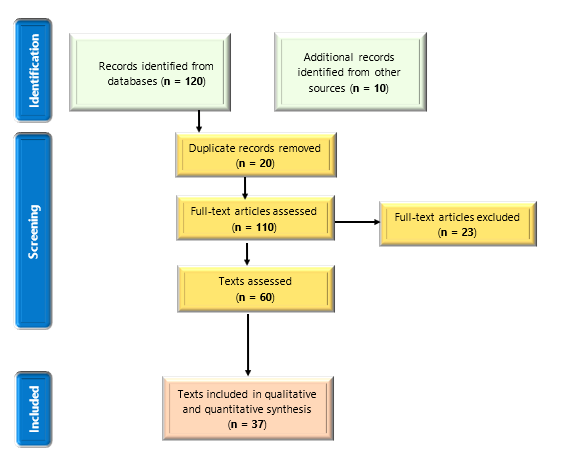
phases, following a systematic approach that can be represented using a PRISMA
flow diagram. Initially, a total of 120 articles were identified through
the Scopus, Web of Science, and Google Scholar databases, using the predefined keywords and filters.
Figure 1
PRISMA flow diagram
Note:
The
researcher (2026).
In the identification phase, 120
records were located in databases
and 10 additional records were identified through other sources. After
removing 20 duplicates (e.g., not related to Colombia, outside the date
range, or not pertinent to the topic), 110 records remained for
screening. This resulted in 150 articles for full-text review.
In the screening stage, these 110
records were reviewed by title and abstract, excluding 50 for not
meeting relevance criteria, such as lack of relevant data, inadequate
methodology, or not directly addressing bilingualism policies in Colombia,
leaving 60 full-text articles for analysis. During the eligibility
assessment, these 60 full-text articles were evaluated, of which 23 were
excluded for not conforming to the established criteria.
Finally, 37 articles met all the inclusion
criteria and were used for the analysis and synthesis of this reflective
article. Relevant data from each article, such as authors, year of publication,
objectives, methodology, results, and conclusions, were extracted and
synthesized for subsequent analysis.
Data analysis
The information analysis was conducted
qualitatively, identifying recurring themes, trends, challenges, and
opportunities in the implementation of bilingualism policies in Colombia.
Special attention was paid to the discussion on the effectiveness of language
immersion and the role of teacher training, contrasting the findings with the provided government documents and the existing literature.
Results
and discussion
Bilingualism policies in Colombia have undergone a
significant evolution since the 1990s, driven by the growing importance of a
second language in the global context. Initially, the Ley General de Educación of 1994 laid the foundations for recognizing
the nation as multilingual and pluricultural, promoting bilingual and
intercultural ethno-education, along with the teaching of foreign languages.
However, the main focus has centered on English,
seeking the country's insertion into the global economy and universal
communication (Ministerio
de Educación Nacional, 2006).
Milestones and approaches of bilingualism policies
from a detailed retrospective
Undoubtedly, the political trajectory of
bilingualism in Colombia reflects the evolutionary nature of national
priorities and global influences. The Constitución Política de 1991
establishes in Article 10 that the official language is Spanish, but in
"those communities with their own linguistic traditions, [education] will
be bilingual" (Asamblea
Nacional Constituyente, 1991). There is a fundamental
reason for this purpose: the country's ethnic and cultural diversity, hence the
need to respect and promote native languages. However, the phenomenon of
globalization and the increase in economic and cultural interconnectedness have
exerted a shift in focus toward the mastery of foreign languages such as
English (De Mejía, 2006).
Precisely, the governing body of these educational
policies has been the Ministerio
de Educación Nacional, charting the roadmap through programs and
documents for bilingualism in Colombia. In 2004, the NBP was launched as a
comprehensive long-term vision. This required not only teacher training but
also the monitoring of English teaching and learning processes in the country.
The stated purpose was the comprehensive education of students to have citizens
capable of communicating in English (NBP, 2004; Díaz &
Carmona, 2010).
For its part, in 2006 the Estándares
Básicos de Competencias en
Lenguas Extranjeras: inglés
were added. This document set the goal that students, upon completing
secondary education, would have an intermediate B1 level of English. Likewise,
teachers were expected to have an upper-intermediate B2 level, and newly
graduated language teachers a minimum advanced level of C2 (Ministerio de Educación Nacional, 2006). These
levels were comparable to the B1 and B2 levels of the Currículo
para la Excelencia Académica y la Formación Integral.
In this sense, the central approach was established under a Currículo
para la Excelencia Académica y la Formación Integral, which
required going beyond the acquisition of linguistic structures.
The Programa para el Fortalecimiento de Lenguas
Extranjeras (PFDCLE) 2010-2014 sought to develop communicative competencies in
English among educators and students within the educational system to favor the
insertion of human capital into the knowledge economy. The stated purpose was
to complement classroom work for secondary education students through the
development of a mass English program (Ministerio de Educación Nacional,
2013). In this regard, the evaluation of English
competencies through the SABER tests in grades 5 and 9 was included. Meanwhile,
at the higher education level, the Saber Pro tests were promoted so that
students about to graduate or graduates of professional university programs
would achieve the B1 level, that is, reading, grammar, and lexical tasks
according to the Marco Común Europeo (Ministerio de
Educación Nacional, 2022).
Likewise, the program developed accompaniment in
the improvement processes for undergraduate programs that trained English
teachers. At the same time, certification of the quality of institutions with
programs for work-oriented and human development training focused on English
teaching was carried out. Tutoring for secondary school students in a second
language was also included. Furthermore, the use of new technologies in English
teaching was promoted.
Another important milestone was the enactment of Ley
1651 in 2013, also known as the Ley de Fortalecimiento de la Enseñanza del Inglés
en Colombia. This law served as a complement to Ley 115
of 1994. This legal norm was oriented within public educational policy to
improve the quality and competitiveness of citizens through the mastery of
English as a second language. This law applies to all levels of the Colombian
educational system, from preschool to higher education. Likewise, it
establishes training and professional development programs so that teachers can
teach English with quality, following international standards such as the Marco Común
Europeo de Referencia para las Lenguas. It also sets
forth the evaluation of communicative competencies in English through national
and international tests.
Likewise, the program developed accompaniment in
the improvement processes for undergraduate programs that trained English
teachers. At the same time, certification of the quality of institutions with
programs for work-oriented and human development training focused on English
teaching was carried out. Tutoring for secondary school students in a second
language was also included. Furthermore, the use of new technologies in English
teaching was promoted.
Another important milestone has been the Programa
Nacional de Inglés (PNI) 2015-2025,
known by the slogan "Colombia Very Well," which is an
initiative of the Ministry of National Education to strengthen the learning of
English as a foreign language at all levels of the educational system so that
Colombia can achieve international standards and benefit from greater opportunities
in education, employment, and international mobility (Ministerio de Educación Nacional,
2014).
Impact on higher education and language immersion
Language immersion is understood as a
pedagogical approach in which a second language is used as the medium of
instruction to teach academic content in order to
develop linguistic competence (Genesee, 1987).
However, Bostwick (n.d.) argues
that this new language is not only the medium of instruction but also the
object of it. In this sense, in immersion, the foreign language is used as a
tool that enables the learning of other disciplines, thus creating an authentic
and meaningful environment.
It should be noted that the impact of
these policies on higher education has been mixed. While the teaching of
English and the pursuit of higher proficiency levels (B1, B2 according to the
CEFR) have been encouraged, the effectiveness of language immersion as a
pedagogical strategy has been the subject of debate. Immersion, which seeks to
maximize student exposure to learning in a second language (L2) in academic and
everyday contexts, has proven effective in other contexts for developing
additive bilingual competence (Cummins, 2000).
However, in Colombia, the implementation
of immersion programs has faced challenges related to the availability of
qualified teachers, adequate resources, and the homogeneity of students' entry
levels. As well as the fact that not all institutions meet the required
standards because they lack the necessary resources to facilitate teaching and
learning processes to achieve communicative competencies in English (García et al., 2018). Likewise, it has been found that
beliefs about foreign language learning play a significant role, especially in
promoting the development of communicative competence (Gómez,
2018). It should be noted that debates and
criticisms have arisen regarding this positioning of English as the dominant
language to be learned throughout the educational system and as a tool for
international competitiveness (Roux & Soler Millán, 2023).
Recent studies indicate that the goal of achieving
bilingualism in Colombia by 2025 seems unattainable (Ramos et al.,
2021). Other research maintains that not only does the
achievement of this goal remain very low, but also no significant improvement
is observed (Benavides, 2021). But what
is the reason behind this situation? It appears that one of the most
predominant factors is the lack of continuity in its implementation, from a
structural point of view. However, at the specific or operational level, it has
been pointed out that the weaknesses lie in the "number of hours and
methodological and evaluation practices that affect program contents and
student performance" (Jiménez et al., 2017).
Nevertheless, there are those who consider that there are few opportunities for
teachers provided by the MEN (Bastidas & Muñoz, 2015). Likewise,
the level of students upon completing their university studies has not shown
significant improvement in recent years (Benavides,
2021).
On the other hand, it is worth mentioning that
Colombia ranks among the lowest in terms of bilingualism, occupying 74th place
out of 116 countries, and at the Latin American level, it ranks 17th out of 21
(EF
English Proficiency Index, 2025). Furthermore, 43% of teachers in Colombia are
trained in English, and only 5% of eleventh-grade students (Milanés,
2025). The ICFES tests indicate low levels in English,
and this is due to formative and cultural processes that have not achieved an
optimal level in students, with the majority at the basic level (A1) (Amaya
& Osorio, 2021).
For their part, Estrada et
al. (2015) and Sánchez et al. (2016)
point out that there is limitation and lack of teacher
quality, which calls for the development of formative scenarios that favor
bilingual learning in students. Likewise, it has been found that participants'
beliefs about language learning are related to the impact on motivation and
academic performance (Sierra et al., 2024).
Also at the structural level, the literature
suggests that foreign language acquisition depends on exposure to communicative
situations in which students can understand the message, even without fully
mastering the linguistic structure (Krashen, 1982).
This implies that an effective immersion environment must provide real
opportunities for interaction in the language, which is not always achieved in
the Colombian educational system due to factors such as class sizes, lack of
authenticity in materials, and limited exposure outside the classroom.
The role of teacher
training
The author of this article agrees with Vergara
and Gómez (2020) that to teach a language, whether native or
foreign, the teacher must have both linguistic and pedagogical training. These
elements are fundamental because bilingualism serves as a bridge between
language and identity. Moreover, bilingual learning enhances not only cognitive
development but also self-esteem (Gupa,
2019).
Achieving the aforementioned
goals requires teacher training. Galindo and
Moreno (2019) state that in Colombia, academic events have
been held twice a year, such as regional, national, and international
conferences for foreign language development, but there are also language
refresher programs developed by institutions. Likewise, language level
certification has been carried out.
In this sense, "the Ministerio
de Educación Nacional de Colombia, in its pursuit of
improving the quality of national education, has committed to the continuous
training of teachers" (Osorio, 2016, p. 47). It follows
from this that in Colombia there is a shortage of English teachers that fails
to cover the entire student population, and this makes it necessary to consider
both initial and ongoing teacher training. Teacher training is defined as
"constant learning, bringing it closer to the development of professional
activities and to professional practice, and from it" (Imbernón, 2007, p. 11).
This teacher training implicitly includes continuous training because the
teacher is "a professional capable of mastering their own evolution,
building new competencies and knowledge based on what they have acquired and
their own experience" (Perrenoud, 2007, p. 23).
Thus, the Ministerio de Educación Nacional,
as the governing body of educational policies of the Colombian government, has
set itself the great goal of a Bilingual Colombia, and therefore teacher
training is a way to sensitize and raise awareness among English teachers about
their responsibility and commitment to the State and the country in the
formation of new generations, which is why they must train themselves and
achieve English proficiency levels. This is why, as Vaillant and Marcelo
(2015) affirm, in training, both the capacity and the will
of each person are key elements in formative processes.
According to official MEN documents, various
efforts have been made in Colombia to strengthen English teaching. One of the
main objectives set is to ensure that "100% of
English teachers are at the B2 level" (Colombia,
MEN, 2012). To advance toward this goal, the Ministry
established, in partnership with a training institution, the so-called
"English Training Strategy in Cascade Scheme," which seeks to train
and benefit a group of 3,000 teachers throughout the country, thus promoting a
significant improvement in their linguistic competencies and in the quality of
education they offer to students.
Conclusions
Bilingualism policies in Colombia have demonstrated
a clear intention to position the country within a globalized context,
prioritizing the learning of English as a second language. However, the
critical analysis of their evolution and impact reveals a gap between the
stated objectives and the results achieved, particularly in higher education
and with regard to teacher training.
Language immersion, although recognized as an
effective pedagogical strategy, has encountered limitations in its application
due to the lack of resources, the heterogeneity of student proficiency levels,
and, fundamentally, the insufficient preparation of teachers. The success of
these policies cannot depend solely on the enactment of laws and programs but
requires substantial and sustained investment in the professional development
of educators. It is imperative that teacher training transcends mere language
proficiency and focuses on second language teaching methodologies, including
immersion pedagogy, assessment, and curricular adaptation.
For future bilingualism policies in Colombia, the
following recommendations are put forward: (a) Strengthen initial and ongoing
teacher training in second language didactics and bilingualism, ensuring that
teachers acquire not only linguistic but also pedagogical competence. (b)
Develop language immersion programs contextualized to the Colombian reality,
considering the particularities of each region and educational level. (c)
Promote research on the effectiveness of different second language teaching strategies
in the Colombian context. (d) Establish rigorous evaluation and monitoring
mechanisms that allow policies to be adjusted based on results and the needs of
the educational system. (e) Promote a more inclusive vision of bilingualism
that also values and strengthens the country's indigenous and creole languages,
in line with its multilingual and pluricultural character.
Privacy: Not
applicable.
Declaration on the use of
artificial intelligence: The author of this article
declares that no artificial intelligence has been used in its preparation.
References
Amaya, G. I. A. and Ososrio, A. V. M. (2021). El bilingüismo en Colombia:
tendencias motivacionales y sus consecuencias sociales. pp. 29-45. En Ramos, A.
L. Izquierdo, A. A. S. (2021). La investigación formativa y su incidencia en
la educación superior. Tomo II. REDIPE Red Iberoamericana de Pedagogía.
https://www.englishatuniversity.com/files/Libro-Investigacion-REDIPE-UCEVA-2021.pdf
Asamblea Nacional
Constituyente. (1991). Constitución Política de la República de Colombia. https://www.funcionpublica.gov.co/eva/gestornormativo/norma.php?i=4125
Bastidas, A. J. A. and
Muñoz, I. G. (2015). Fundamentos para el desarrollo profesional de los
profesores de inglés. (2nd ed). Editorial Universidad de Nariño.
Benavides, J. E. (2021).
Level of English in Colombian Higher Education: A Decade of Stagnation. Profile:
Issues in Teachers' Professional Development, 23(1), 57–73.
https://doi.org/10.15446/profile.v23n1.83135
Bernal, S. E. C., Coronado,
R. C. C., Morello, V. M. M. & Tiuso, H. A. J. (2025). Perceptions and
beliefs about english learning in the community outreach unit of a colombian
university. Colombian Applied
Linguistic Journal, 27(1), 1-16.
https://revistas.udistrital.edu.co/index.php/calj/article/view/20113/20834
Bostwick, M. (s.f). Immersion
Education & Bilingualism. https://www.google.com/url?sa=t&rct=
j&q=&esrc=s&source=web&cd=&cad=rja&uact=8&ved=2ahUKEwii3Napq9iOAxVfmIQIHcffK1EQFnoECD8QAQ&url=http%3A%2F%2Fbi-lingual.com%2Fabout_us_0151.php&usg=AOvVaw1eu4VW08BJHGJ-H0NS1m9d&opi=89978449
Cummins, J. (2000). Language,
power, and pedagogy: Bilingual children in the crossfire. Multilingual Matters.
De Mejía, A. M. (2006).
Bilingual education in Colombia: Towards a reconceptualization. International
Journal of Bilingual Education and Bilingualism, 9(3), 349-365.
https://doi.org/10.2167/beb368.0
Díaz, M. A. E. and Carmona,
A. N. C. (2010). Representaciones de los docentes de inglés. sobre el proceso
de formación integral: ¿qué descripción ofrecen de ella? Íkala. Revista de
lenguaje y cultura, 15(1), pp.173-203.
EF English Proficiency
Index (2025). Índice de dominio del inglés de EF.
https://www-ef-com.translate.goog/wwen/epi/regions/latinamerica/colombia/?_x_tr_sl=en&_x_tr_tl=es&_x_tr_hl=es&_x_tr_pto=sc
Estrada, V. J., Mejía, M.
J. and Rey, V. J. (2015). Bilingüismo en Colombia: Economía y sociedad. Dimensiones
del desarrollo económico, 5(2), 50-58.
https://journal.universidadean.edu.co/index. php/plou/article/view/1491
Fandiño, P. Y. J.,
Bermúdez, J. J. R. and Lugo, V. V. E. (2012). Retos del Programa Nacional de
Bilingüismo. Colombia Bilingüe. Educación y Educadores, 15(3), 363-381.
https://www.redalyc.org/pdf/834/83428627002.pdf
Galindo, A. and Moreno, L
M. (2019). Educación bilingüe (español-inglés) en tres instituciones educativas
públicas del Quindío, Colombia: estudio de caso. Len, 47(2),
http://www.scielo.org.co/scielo.php?
script=sci_arttext&pid=S0120-34792019000300648
García, M., Dussan, V. and
Jaime, M. (2018). Una reflexión sobre el ejercicio de la investigación en el
área de la enseñanza del inglés a estudiantes pertenecientes a población
vulnerable en Neiva. Revista Erasmus Semilleros de investigación, 2(1),
38-48. https://journalusco.edu.co/index.php/erasmus/article/view/2418/3617
Genesee, F. (1987). Learning
through two languages: studies of immersion and bilingual education. Newbury
House.
Gómez, J. (2018).
Diferencias en las creencias entre hombres y mujeres acerca del aprendizaje del
idioma inglés. Revista signos. Estudios de lingüística, 51(97), 193-213.
https://dx.doi.org/10.4067/S0718-09342018000200193
Gupa, A. (2019). Principles
and Practices of Teaching English Language Learners. international education
studies, 12(2), 49-57. DOI:10.5539/ies.v12n7p49
Imbernón, F. (2007).
Diversas orientaciones conceptuales en la formación del profesorado. En La
formación y el desarrollo profesional del profesorado. Hacia una nueva cultura
profesional. 7a ed. Graó.
Jiménez, M., Rodríguez, C.,
& Rey, P. L. (2017). Standardized test results: An opportunity for English
program improvement. How, 24(2), 121-140.
https://doi.org/10.19183/how.24.2.335
Krashen, S. D. (1982).
Principles and practice in second language acquisition. Pergamon Press.
Ley de Fortalecimiento de
la Enseñanza del Inglés. (2013).
Milanés, A, L. M. (2023). La
Inmersión Lingüística: una estrategia fundamental para el aprendizaje del
inglés como lengua extranjera en estudiantes de básica secundaria del plantel
educativo: Nuestra Señora del Carmen de Bogotá. Trabajo de grado presentado
como requisito para optar al título de Magíster en Educación. Fundación
Universitaria Los Libertadores.
https://repository.libertadores.edu.co/server/api/core/bitstreams/7f59d6ef-1713-499e-a2ea-90bb62c5da4b/content
Ministerio de Educación
Nacional (2014). Programa Nacional de Inglés (PNI) 2015-2025.
https://www.academia.edu/32878359/PROGRAMA_NACIONAL_DE_INGLÉS_2015_2025
Ministerio de Educación
Nacional. (2006). Estándares Básicos de Competencias en Lenguas Extranjeras:
inglés. Formar en lenguas extranjeras: Inglés! El reto!
https://www.mineducacion.gov.co/1780/articles-115174_archivo_pdf.pdf
Ministerio de Educación
Nacional. (2012). Estrategia de formación en inglés en esquema de cascada. https://www.mineducacion.gov.co/1759/w3-article-314395.html?_noredirect=1
Ministerio de Educación
Nacional. (2013). Programa para el Fortalecimiento de Lenguas Extranjeras
(PFDCLE) 2010-2014.
Ministerio de Educación
Nacional. (2022). Examen Saber Pro Icfes.
https://www.icfes.gov.co/wp-content/uploads/2024/11/Infografia_Ingles_Saber_Pro_2022.pdf
Osorio, A. M. (2016). El
desarrollo profesional docente en educación básica primaria. Revista
Latinoamericana de Estudio Educativos, 12(1), 39-52.
https://revistasojs.ucaldas.edu.co/index.php/latinoamericana/article/view/4036/3744
Perrenout, Ph. (2007). Desarrollar
la práctica reflexiva en el oficio de enseñar. Profesionalización y razón
pedagógica. Graó.
Ramos, P. C., Gamoa, M. M.
C. and Morales, B. M. (2021). El Ministerio de Educación lanzó el proyecto
Colombia, la mejor educada en el 2025. EducaT: Educación Virtual, Innovación
y Tecnologías, 2(2), 53-64. DOI:
https://doi.org/10.22490/27452115.5308
Roux, G., & Soler
Millán G. C. (2023). Unilingualism and unibilingualism in
Colombia. Applied Linguistics, 45(2),
348–363.
https://doi.org/10.1093/applin/amad030
Sánchez, V. G., Gómez, C.
C. A., Ortiz, P. D., Clavijo, G. T. A. and Váquiro,
R. L. P. (2016). Percepción Social Importancia del inglés e Inclusión de
Videojuegos como herramienta de aprendizaje. Amazonia Investiga, 5(8),
58-66. http://www.udla.edu.co/revistas/index.php/amazonia -investiga
Vaillant, D. and Marcelo,
C. (2015). El abc y d de la formación docente. Narcea.
Vergara, F. M. and Gómez,
P. S. (2020). Formación de docente bilingües. Revista Paradigmas
Socio-Humanísticos, 2(1), 54-67. DOI:10.26752/revistaparadigmassh.v1i2.471
Article received date: March 7, 2026
Article acceptance date: April 6, 2026
Date approved
for layout: April 10,
2026
Publication date: June 30, 2026